Quick answer: In the Pirate Chain exploit, a validation bug let an attacker mint about 39.8 million ARRR on Oct. 14, 2026, roughly 20% more supply. The coins went straight into the Sapling shielded pool. The team first planned a rollback, then dropped it and asked users not to move funds.
The Pirate Chain exploit let an attacker create about 39.8 million ARRR out of thin air on Oct. 14, 2026, roughly a 20% jump in supply. The team has now dropped its plan to roll the chain back and instead asks users, exchanges and miners to stop moving funds while it builds a recovery plan.
As a result, this is more than a bug report. It is a live test of how a privacy coin handles counterfeit money it cannot fully see.
What happened in the Pirate Chain exploit?
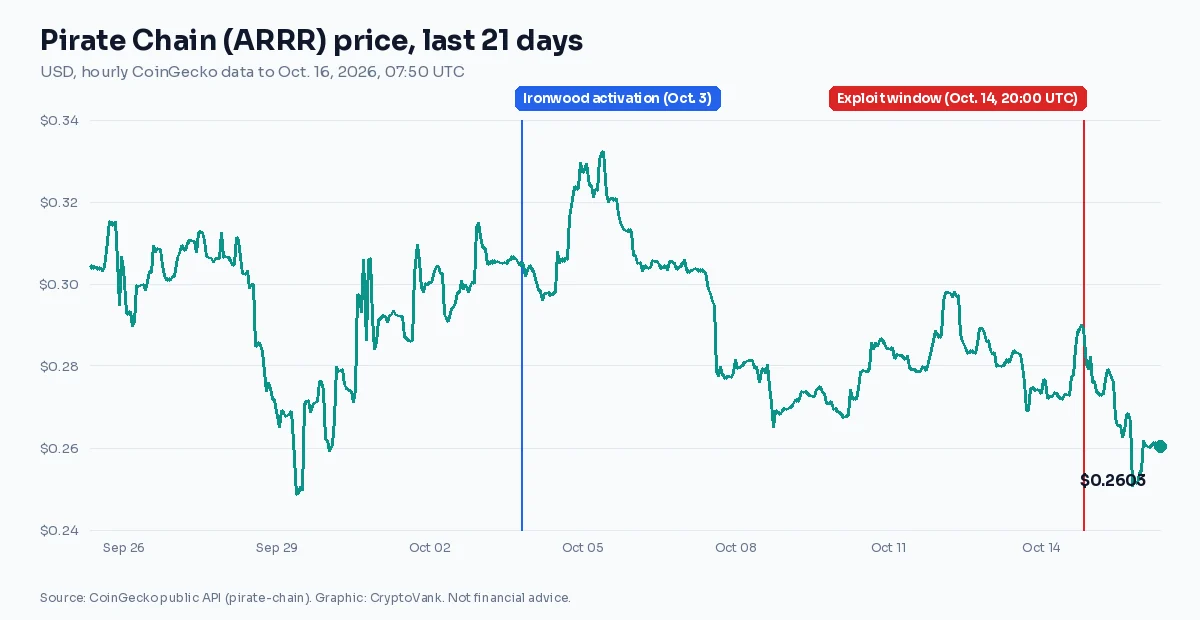
Pirate Chain first flagged the problem on X at about 02:20 UTC on Oct. 15. Its first post blamed “an exploit in the new transparent layer related to the Ironwood turnstile for supply accounting.” At that point, developers also planned to roll the chain back to 1:00 p.m. Pacific Time on Oct. 14 (20:00 UTC).
About 14 hours later, a follow-up update changed course. The team confirmed the unauthorized issuance of roughly 39.8 million ARRR. It also said the new coins moved “immediately” into the Sapling shielded pool, where balances and transfers are hidden.
According to the project, the attack chained two validation failures:
- a bypassed issuance check, the rule that stops coins from appearing outside the protocol;
- a wrong reading of output scripts, which define where coins go and how they can be spent.
On the bright side, the team said it saw no sign that anyone broke the notary keys or the zk-SNARK cryptography behind shielded payments. One exchange, NonKYC, spotted suspicious deposits, restricted the account and blocked withdrawals, The Crypto Times reported.
Why was the rollback dropped?
The second statement said it is “not possible to freeze the network or unilaterally rollback its blockchain history” because Pirate Chain is decentralized. So instead of a rewind, the project chose a voluntary pause.
Delayed Proof of Work (dPoW) operators agreed to suspend notarizations for now. dPoW normally anchors Pirate Chain’s state to another chain to guard against double-spends. Meanwhile, the team asked exchanges and mining pools to halt operations and told users not to send funds. Even so, the chain itself keeps running.
In our view, this U-turn is the real story. A rollback needs nearly every exchange, pool and node to agree on one version of history. Otherwise, if even a few keep mining the old chain, the network can split. By pausing first, the team buys time without forcing that fight before the post-mortem lands.
Ironwood was live for only 11 days
The flaw sits in Ironwood, an upgrade scheduled to activate on Oct. 3, 2026, at 19:00 UTC. Ironwood moved Pirate Chain from Sapling to a new shielded pool built on Halo2, which needs no trusted setup. In addition, it added a turnstile: a public tally of value entering and leaving shielded pools, so anyone can audit total supply even when single payments stay private.
The irony is sharp. The turnstile exists to catch exactly this kind of inflation. However, the bug lived in the transparent accounting layer around it, not in the core cryptography, the project said. Moreover, Crypto Briefing noted the flaw surfaced only 11 days after activation.
Also, this is not the first supply bug of the month. We covered a separate XRP Ledger overflow bug that could create new XRP, and the Autheo THEO exploit via a Hyperlane bridge earlier this week.
ARRR price and market data
At 07:50 UTC on Oct. 16, ARRR traded at about $0.260, down 6.4% in 24 hours, according to CoinGecko. Meanwhile, its 24-hour range ran from $0.249 to $0.278. Market cap sat near $51.1 million, with 24-hour volume of only about $481,000.
Next, some quick math puts the exploit in context. At $0.26, the 39.8 million minted ARRR carry a paper value of roughly $10.3 million. However, daily volume is under $0.5 million, so dumping that amount would crush the price long before it filled. That thin liquidity, plus NonKYC’s freeze and the exchange pause, likely limits how much the attacker can cash out.
CoinGecko lists about 196.2 million ARRR in circulation against a 200 million total. It is unclear whether aggregator supply figures include the unauthorized coins, so for now treat supply-based metrics with care until the post-mortem.
For contrast, larger privacy coins rose over the same day. Zcash (ZEC) gained about 11.6% and Monero (XMR) about 4%, CoinGecko data show.
What should ARRR holders watch next?
First, the post-mortem. The team promised technical details and recovery steps, which should explain what happens to the minted coins.
Second, watch exchange status. Deposits and withdrawals stay paused at venues that complied. Therefore, a restart will signal the team trusts the fix.
Finally, look for a patched release and the return of dPoW notarizations. Until then, do not move ARRR unless the project says it is safe. For general habits, our guide on how to spot crypto scams covers fake “recovery” offers that often follow hacks.
Pirate Chain exploit FAQ
How many ARRR were created in the Pirate Chain exploit?
About 39.8 million ARRR, roughly a 20% increase in supply, according to Pirate Chain’s Oct. 15, 2026 update on X.
Is Pirate Chain rolling back its blockchain?
No. At first, the team announced a rollback to Oct. 14, 20:00 UTC, but later said a decentralized network cannot unilaterally rewrite its history. Instead, it chose a voluntary pause.
Are Pirate Chain users’ funds safe?
The project said it found no compromise of notary keys or shielded cryptography. Still, it asked users not to send or move funds until the team publishes a recovery plan and post-mortem.
Sources
- Pirate Chain on X: initial exploit and rollback notice
- Pirate Chain on X: import exploit update
- The Crypto Times: rollback plan dropped
- Crypto Briefing: Pirate Chain exploit mints 39.8 million ARRR
- CoinGecko: Pirate Chain (ARRR) market data
Not financial advice. Crypto assets are volatile, and exploited networks carry extra risk. Do your own research (DYOR).