
Quick answer: Titan Builder revenue reached $22.83 million over a 24-hour window ending Oct. 31, 2026, passing Tether’s $16.99 million on DefiLlama’s revenue ranking. The jump came from heavy Ethereum MEV during the Binance hack sell-off, and by Saturday its daily take was back near $400,000.
Titan Builder revenue jumped to $22.83 million over 24 hours, enough to briefly pass Tether at the top of DefiLlama’s protocol revenue ranking. The lead lasted about a day, and it says more about the chaos of the Binance hack sell-off than about a lasting shift in who earns the most in crypto.
What happened to Titan Builder revenue
Titan is an Ethereum block builder. It packs user transactions into blocks and bids for the right to have validators propose them. It sells no token and runs no app.
On Oct. 31, 2026, DefiLlama’s 24-hour ranking showed Titan at $22.83 million. That was ahead of Tether at $16.99 million and Circle at $6.76 million, Crypto Briefing reported. TokenPost put Titan’s fees over a 24-hour window at $24.7 million.
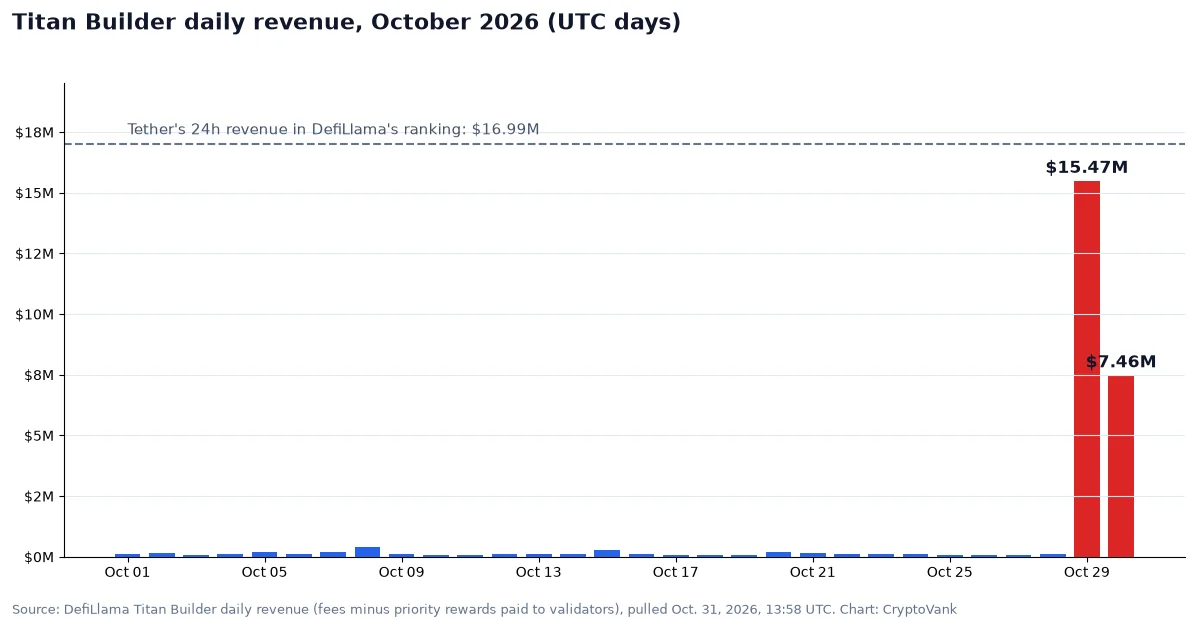
DefiLlama’s own daily data shows where the money landed. Titan booked $15.47 million of revenue on Oct. 29 (UTC) and $7.46 million on Oct. 30. In the seven days before, it averaged about $91,000 a day.
In other words, Oct. 29 alone came in roughly 170 times above a normal day. It was also more than three times Titan’s revenue for the whole of September, which DefiLlama puts at $4.66 million.
Why the spike matters
DefiLlama counts Titan’s revenue as total fees and MEV rewards, minus the priority rewards it passes to validators. MEV, or maximal extractable value, is profit from choosing which transactions go into a block and in what order.
So builder revenue rises when there is more value to capture from ordering. That happens when prices move fast and big trades hit thin pools. Arbitrage bots then compete hard for the best block positions.
Oct. 29 fits that pattern. The Binance hot-wallet drain began at about 20:20 UTC that day. We covered the method in our explainer on EIP-7702 and the Binance hack.
Chainalysis said the attacker swapped $325 million in stablecoins for about $285 million in ETH over nearly 20 minutes to beat freezes. Ether then fell to a two-month low of $2,178, Reuters reported. Large, rushed swaps like these leave price gaps across exchanges and pools, which is the raw material of MEV.
However, neither DefiLlama nor Titan has tied the revenue to specific hack transactions. The link here is timing, not a traced flow.
Data and context: one day is not a business
Tether earns steady interest on the Treasury bills and other assets that back USDT. DefiLlama shows it near $17 million to $17.4 million of revenue on every day of the past week. That income barely moves with market mood.
Builder income works the other way. It sits near zero on calm days and explodes in a crisis. By Oct. 31, Titan’s daily revenue had already fallen back to about $400,000, per DefiLlama.
The seven-day totals tell the real story. Titan made $23.37 million over the week. Tether made $120.21 million and Circle $47.57 million over the same period.
Titan is still a heavy player. It built about 52% of MEV-Boost blocks in October, according to Crypto Briefing. MEV-Boost is the software most validators use to buy blocks from outside builders. That share means one private firm assembles roughly half of those Ethereum blocks.
This concentration has been an open debate for years. Faster block times, such as the change we covered in Base’s Denim upgrade, are one reason chains keep rethinking how blocks get built.
For background on the stablecoin side of the ranking, see our report on Tether’s excess reserves in Q3.
What to watch next
First, watch whether builder revenue stays high when Binance reopens withdrawals. The exchange has said it aims to restart them on Sunday. A rush of transfers and trades could create a second, smaller MEV wave.
Second, watch DefiLlama’s revenue page for any revision. DefiLlama co-founder 0xngmi said its detection systems first quarantined the reading as unusual, Telem reported. So the final figures may still shift.
Third, watch builder market share. If Titan’s share of MEV-Boost blocks climbs further, calls for changes such as enshrined proposer-builder separation are likely to get louder.
At writing time, ether traded at $2,250 and bitcoin at $77,480, up 1.6% and 1.1% over 24 hours, per CoinGecko at 13:58 UTC on Oct. 31, 2026.
Titan Builder revenue FAQ
What is Titan Builder?
Titan Builder is a private Ethereum block builder. It assembles transactions into blocks and sells them to validators through MEV-Boost. It has no token and no public governance.
How did Titan Builder earn more than Tether?
On Oct. 31, 2026, DefiLlama’s 24-hour ranking showed Titan at $22.83 million versus Tether’s $16.99 million. A burst of MEV during the Oct. 29 Binance hack sell-off drove the jump.
Will Titan Builder stay ahead of Tether?
That looks unlikely. Titan’s daily revenue fell back to about $400,000 by Oct. 31, while Tether earns about $17 million a day. Over seven days, Tether made $120.21 million against Titan’s $23.37 million.
Sources
- Crypto Briefing: Titan Builder briefly tops DefiLlama’s 24-hour revenue rankings
- TokenPost: TitanBuilder collected $24.7 million in fees over 24 hours
- DefiLlama: Titan Builder revenue and fees
- DefiLlama: protocol revenue rankings
- Chainalysis: Binance exploit latest findings
- Reuters via GMA News: Binance seeks to shore up confidence after record heist
- CoinDesk: Binance eyes Sunday reopening
- CoinGecko: Ethereum price
This article is for information only and is not financial advice.