Key Takeaways
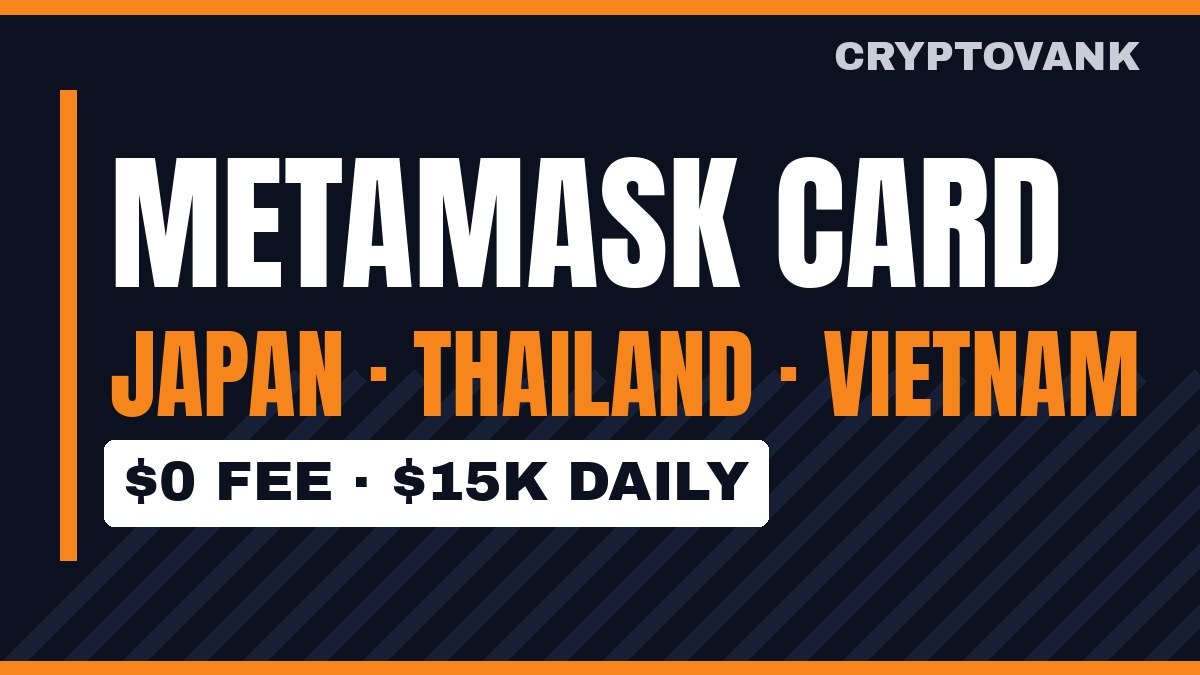
- MetaMask Card went live in Japan, Thailand and Vietnam on Nov. 25, 2026; in these markets it spends only mUSD from the self-custodial MetaMask Money account on Monad.
- Japan gets a free virtual Mastercard only, with limits of $10,000 per transaction and $15,000 per day, no ATM withdrawals, and a 1% fee on purchases outside your home country (CoinPost).
- The Japanese card is issued by New Zealand-registered Immersve Limited; Japanese outlet Atarashii Keizai found no matching entry in Japan’s FSA payment registries.
MetaMask has switched on its crypto debit card in three Asian markets. Since Nov. 25, 2026, residents of Japan, Thailand and Vietnam can sign up for the MetaMask Card and spend from a self-custodial wallet at any Mastercard merchant, the wallet maker said on X.
The Asian version is narrower than the card sold in Europe or Latin America. It runs on one stablecoin, one network and, in Japan at least, a virtual card only. Here is what you get, what it costs, and where the fine print bites.
The launch lands as dollar stablecoins push deeper into everyday payments in Asia. Bitcoin (BTC-USD) traded at $60,876 on Nov. 26 (CoinGecko), but this card is about spending dollars, not crypto price exposure.
How does the MetaMask Card work in Japan, Thailand and Vietnam?
In all three countries, the card draws only on mUSD, MetaMask’s own U.S. dollar stablecoin, held in the in-app “Money Account” on the Monad network. That is spelled out on MetaMask’s official card page.
When you pay, the required mUSD converts to yen, baht or dong at the Mastercard rate at checkout. Funds stay in your self-custodial account until the moment of purchase, so there is no exchange account in the middle.
Holding USDC, ETH or another token? You must swap it into mUSD and move it into the Money Account first, CoinPost reported. MetaMask said in June that mUSD is backed 1:1 by U.S. dollars and short-term Treasuries, per the same report.
How does the Asian version compare with other regions?
MetaMask’s FAQ lists different setups by region. The gap between the Asian rollout and the broader card is large:
| Feature | Japan / Thailand / Vietnam | UK | Other supported regions |
|---|---|---|---|
| Spendable tokens | mUSD only | USDC only | mUSD, wETH, EURe, GBPe, USDC, USDT |
| Network | Monad (Money Account) | Base | Linea, Base, Monad, Solana |
| Card type | Virtual (Japan: virtual only) | Varies | Virtual free; metal $199/yr |
| Mobile wallets | Apple Pay, Google Pay (confirmed for Japan) | Varies | Varies |
Note that U.S. sign-ups are “temporarily closed,” according to MetaMask’s site, so the Asian launch comes while its original market is paused.
What are the MetaMask Card fees and limits in Japan?
CoinPost, citing MetaMask’s support pages, lists these terms for Japan. The annual fee is $0. Paying from the mUSD balance carries no fee in your country of residence.
Spend at a merchant outside your home country and a 1% fee applies. That is lower than many bank cards’ foreign transaction charges, but it adds up for frequent travellers.
| Term (Japan) | Detail |
|---|---|
| Annual fee | $0 |
| Card format | Virtual only; no physical card for new Japan applicants |
| Domestic purchase fee (from mUSD) | None |
| Purchase outside country of residence | 1% |
| Per-transaction limit | $10,000 (about ¥1.59 million) |
| Daily limit | $15,000 |
| ATM cash withdrawals | Not supported |
| App requirement | Mobile app version 8.21 or later, “Money” tab |
To put the 1% fee in context: a traveller from Japan spending $2,000 in Thailand would pay about $20 in card fees. Our guide to crypto card fees explains the other costs to check, including spreads on conversion.
How do you apply for the MetaMask Card?
The steps, per CoinPost and MetaMask’s Japanese card page, are straightforward:
- Update the MetaMask mobile app to version 8.21 or later.
- Open the “Money” tab and start the card application.
- Register an email address and phone number.
- Complete identity verification (KYC) and provide proof of address.
- Fund the Money Account with mUSD, swapping from other tokens if needed.
- Add the virtual card to Apple Pay or Google Pay for in-store tap payments.
Applicant data goes to the card issuer, not MetaMask, CoinPost reported. If you are new to crypto cards, start with our explainer on what a crypto card is.
Who issues the MetaMask Card in Japan, and is it registered?
MetaMask’s Japanese page says the card is issued by Immersve Limited, registered on New Zealand’s Financial Service Providers Register (FSP1003031), under a Mastercard license.
Japanese outlet Atarashii Keizai checked local registries and did not find Immersve on the Financial Services Agency’s list of electronic payment instrument dealers (as of Aug. 27), nor on the FSA’s lists of funds transfer or crypto-asset exchange businesses. Only SBI VC Trade and Coincheck appear on that dealer list, and neither handles mUSD, it said.
The outlet also could not confirm from public documents which entity is the counterparty when mUSD is converted at the point of sale. That is not a finding of wrongdoing, but it is a regulatory question Japanese users should weigh.
Does the MetaMask Card pay cashback in Asia?
Not clearly. MetaMask runs a rewards program that pays 1% to 3% cashback in mUSD on certain transactions in select regions, according to Crypto Briefing. The $199-a-year metal card is tied to those perks in other markets.
Whether rewards extend to Japan, Thailand or Vietnam had not been confirmed at launch. If cashback matters to you, check the rewards tab in the app after sign-up rather than assuming the European rates apply.
Who should use the MetaMask Card in Asia?
It fits a specific user. If you already hold dollar stablecoins in self-custody and want to spend them without sending funds to an exchange first, the card removes a step. The $0 fee and high limits make it usable for daily spending.
It is a weaker fit if you want to spend BTC, ETH or several stablecoins directly, need cash from ATMs, or want a physical card in Japan. Travellers should budget for the 1% cross-border fee.
For regional context, stablecoin payment rails are moving fast in Southeast Asia, as our report on BLOOM stablecoin pilots across Malaysia, Thailand and Singapore shows.
What to Watch Next
- Japanese regulators: Any FSA comment on Immersve’s status or on mUSD conversions for Japanese residents.
- Rewards: Whether MetaMask switches on its 1%–3% mUSD cashback for Japan, Thailand and Vietnam.
- Token support: Expansion beyond mUSD on Monad to USDC or USDT, as in other regions.
- U.S. reopening: MetaMask says U.S. sign-ups are temporarily closed; a restart would signal broader issuer capacity.
Terms are as reported on Nov. 25–26, 2026 and may change. Not financial advice.