Quick answer: Bitcoin hashrate is back above 1 ZH/s (1,000 EH/s) on a seven-day average, its highest level since March 3, 2026, according to BlocksBridge Consulting’s Miner Weekly of Oct. 22, 2026. Difficulty rose 5.92% to 140.58 trillion on Oct. 16, even though large public miners are moving power to AI.
Bitcoin hashrate is climbing back to levels not seen since early spring, and it is doing so while the biggest listed miners unplug machines to rent their power to AI companies. That gap between the headlines and the network data is the story miners and traders are watching this week.
According to BlocksBridge Consulting’s Miner Weekly, published on Oct. 22, 2026, the seven-day average hashrate regained 1 zettahash per second (ZH/s), or 1,000 exahashes per second (EH/s), the highest reading since March 3. Cointelegraph and CoinMarketCap reported the same figure on Oct. 22.
How high is Bitcoin hashrate right now?
Data from mempool.space shows a 30-day average of about 999 EH/s through Oct. 22, 2026, the highest 30-day reading since late March. Its live estimate stood near 1,033 EH/s at 00:55 UTC on Oct. 23.
The network is still below its peak. The same data shows daily hashrate topped 1,300 EH/s in late October 2025, so today’s level is a recovery, not a record.
Hashrate is the total computing power miners point at Bitcoin. More hashrate makes an attack on the network more expensive, which is why analysts read it as a security and confidence signal.
Why is mining difficulty rising so fast?
Bitcoin resets its mining difficulty every 2,016 blocks, roughly every two weeks, so blocks keep arriving about every 10 minutes. When new machines come online, blocks come faster and difficulty climbs at the next reset.
On Oct. 16, 2026, at block 971,712, difficulty rose 5.92% to 140.58 trillion, its highest since March 5, according to Bitcoin.com News. That is about 12% above the 125.81 trillion low set on Aug. 23.
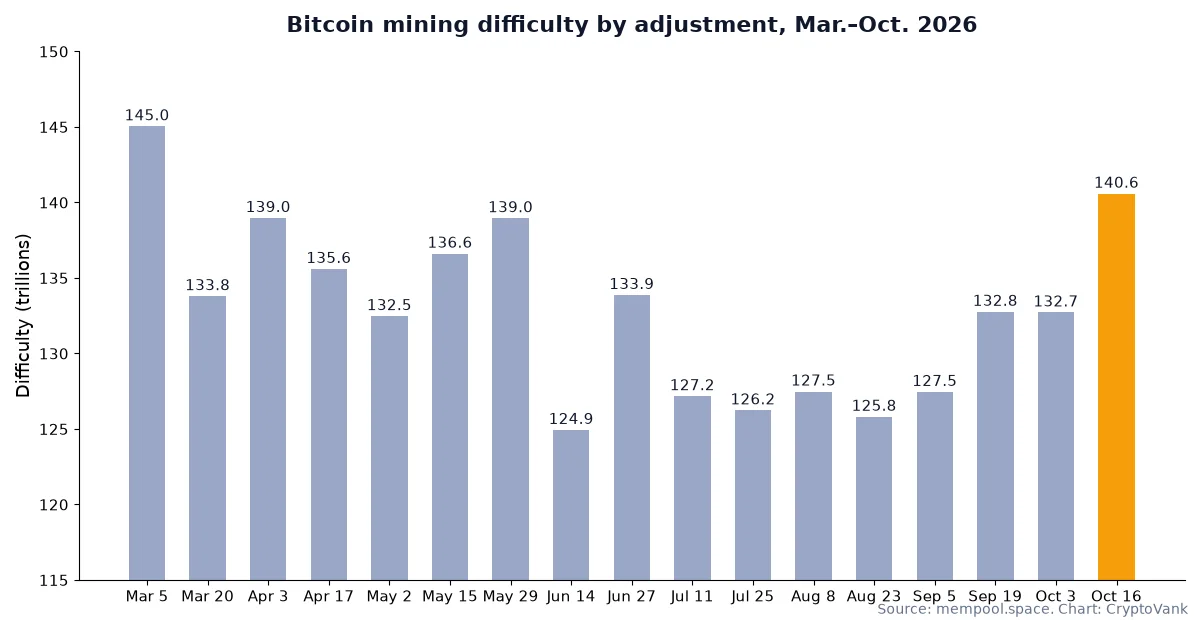
The next reset could add more. BlocksBridge projected about 5.16% on Oct. 22, while mempool.space showed an estimate of about 3.1% at 00:55 UTC on Oct. 23, with the adjustment expected around Oct. 30. These estimates move with every block, so treat them as a range, not a forecast.
If miners are moving to AI, who is adding the power?
The AI shift is real. BlocksBridge said publicly traded miners’ realized hashrate fell 23% while their reported AI and high-performance computing revenue rose 52% in a quarter. It valued the displaced machines at roughly $1.5 billion. We covered one example in MARA’s 996 BTC move to Galaxy.
The replacement power is coming from several places:
- Bitdeer kept growing. Its September update showed self-mining capacity of 82.3 EH/s, up from 79.9 EH/s in August, plus 28.7 EH/s of co-mining, per BlocksBridge.
- Used rigs are finding new homes. Smaller operators with cheap electricity are buying secondhand machines, such as Antminer S21 XP units sold through hosting services in Paraguay and Texas.
- Private and non-listed miners do not report monthly, so their growth only shows up in network data.
CryptoQuant CEO Ki Young Ju wrote on X on Oct. 22 that miners are “running at full capacity” and called it “an indirect bullish signal from institutional investors.”
What does it mean for miner profits?
More competition splits the same reward among more machines. With 3.125 BTC per block, about 0.018 BTC in average fees per block over the past week, roughly 999 EH/s and Bitcoin at $81,434 (CoinGecko, 00:55 UTC Oct. 23), our estimate puts hashprice near $37 per PH/s per day. That is close to the $36.75 Bitcoin.com reported on Oct. 16 and below the $41 seen in early October.
Miners with older machines or expensive power feel this first. Pool choice matters too, with Binance Pool shutting down by Nov. 10.
What does rising hashrate mean for Bitcoin’s price?
Hashrate does not move price on its own. It follows price with a lag, because miners add machines when revenue looks good. Bitcoin fell about 3.3% in 24 hours to around $81,400 on Oct. 23, testing the zone near the Bitcoin ETF cost basis.
The market implication is about selling pressure. Miners who keep expanding while margins tighten may sell more of the coins they mine to pay bills. On the other hand, a network running at near-record power shows operators still expect Bitcoin to be worth mining. Track the live price on our Bitcoin price page.
Bitcoin Hashrate FAQ
What is Bitcoin hashrate?
Bitcoin hashrate is the total computing power miners use to secure the network, measured in hashes per second. On Oct. 22, 2026, the seven-day average was back above 1 ZH/s, or 1,000 EH/s, per BlocksBridge Consulting.
Is Bitcoin hashrate at an all-time high?
No. The seven-day average is at its highest level since March 3, 2026, but mempool.space data shows daily hashrate topped 1,300 EH/s in late October 2025.
Why are Bitcoin miners moving to AI?
Listed miners own power contracts and data centers that AI companies will rent for steady income. BlocksBridge reported their AI and high-performance computing revenue rose 52% in a quarter while their mining hashrate fell 23%.
When is the next Bitcoin difficulty adjustment?
The next reset is at block 973,728, which mempool.space estimated for around Oct. 30, 2026. Early estimates ranged from about 3% to 5% higher as of Oct. 22 and 23.
Does higher hashrate mean Bitcoin’s price will rise?
Not directly. Hashrate usually follows price because miners add machines when revenue is strong. It signals network security and miner confidence, not a short-term price move.
Not financial advice. Crypto is volatile; do your own research (DYOR) before making any decision.
Sources
- BlocksBridge Consulting Miner Weekly via TheEnergyMag (Oct. 22, 2026)
- Cointelegraph: Bitcoin hashrate hits seven-month high (Oct. 22, 2026)
- CoinMarketCap Academy: hashrate uptrend and CryptoQuant view
- Bitcoin.com News: difficulty jumps 5.92% (Oct. 16, 2026)
- Ki Young Ju on X (Oct. 22, 2026)
- mempool.space hashrate and difficulty data
- CoinGecko Bitcoin price