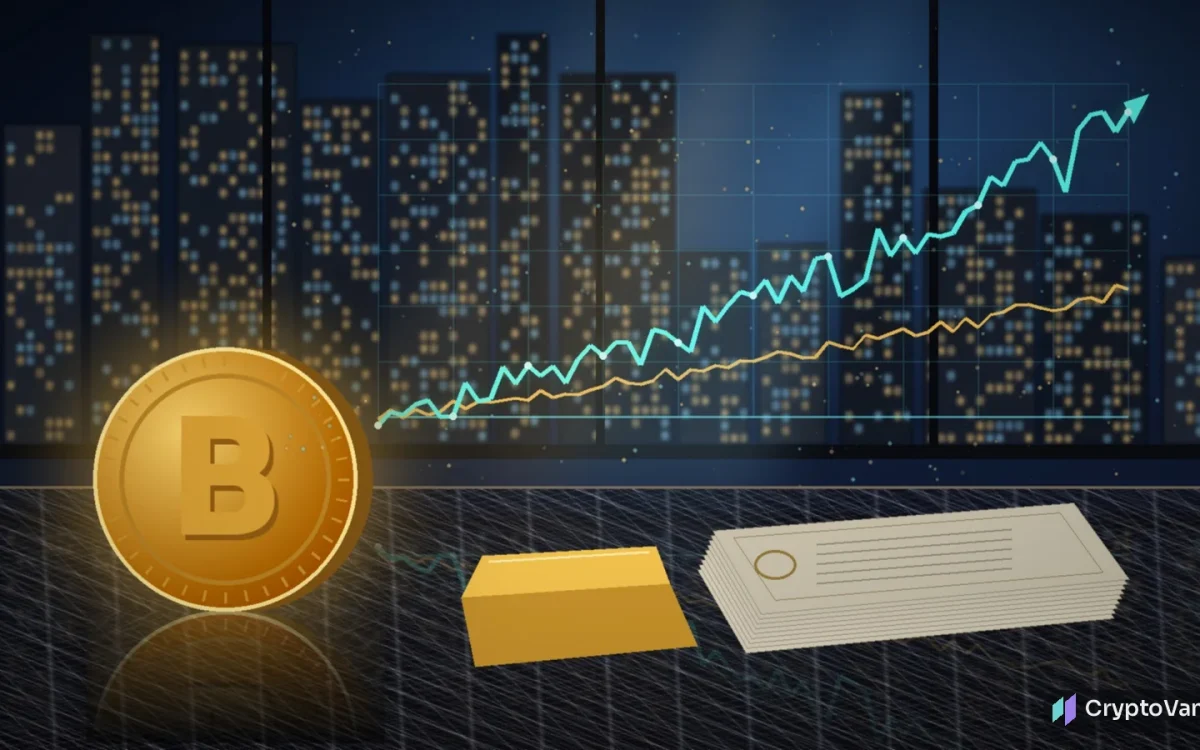
Quick answer: The JPMorgan bitcoin forecast in the bank’s 2027 Long-Term Capital Market Assumptions, published Oct. 19, 2026, is a 10% annualized return over the next 10-15 years. That beats its 7.5% call for U.S. large-cap stocks and 5.5% for gold, but the bear case is a loss of about 11% a year.
The JPMorgan bitcoin forecast is out, and it puts BTC at the top of the table. J.P. Morgan Asset Management now expects bitcoin to return 10% a year over the next 10 to 15 years, more than any stock, bond or gold forecast in its 2027 outlook.
What happened
J.P. Morgan Asset Management published the 31st edition of its Long-Term Capital Market Assumptions (LTCMA) on Oct. 19, 2026. The report sets return and risk assumptions for more than 200 assets, and big investors use it to plan portfolios.
For the first time, the bank “put a range on bitcoin returns.” The base case is a 10% annualized compound return. Cointelegraph and Crowdfund Insider report a bear case of -11.2% a year and a bull case of 16.6%. CoinDesk gives a slightly different range, -9.7% to 17%.
The same report forecasts 7.5% for U.S. large-cap stocks, 5.5% for gold, 5.3% for global aggregate bonds and 7.0% for a 60/40 stock-bond portfolio. Its price data runs to Sept. 30, 2026, when bitcoin traded near $83,000.
Why the JPMorgan bitcoin forecast matters
The number itself is not the big news. The big news is who wrote it. CEO Jamie Dimon called bitcoin a “fraud” in 2017, and now the bank’s asset management arm models it next to equities and bonds.
Still, the bank is careful. Its summary says the “volatility and unstable correlation of assets like bitcoin (BTC) remain an obstacle to their widespread inclusion in portfolios.” So bitcoin stays out of the main covariance matrices that drive its model allocations. Instead, it gets a smaller, separate matrix.
According to CoinDesk, strategists Sheena Shah and Dennis Cristallo call BTC “a speculative asset and a hedge against monetary easing.” In their words, it “lacks a strategic role in portfolios other than as a bet on fiat currency expansion or future asset trading on blockchains.”
In other words, JPMorgan now says what bitcoin might earn. However, it does not yet say how much of it to own.
The data behind the forecast
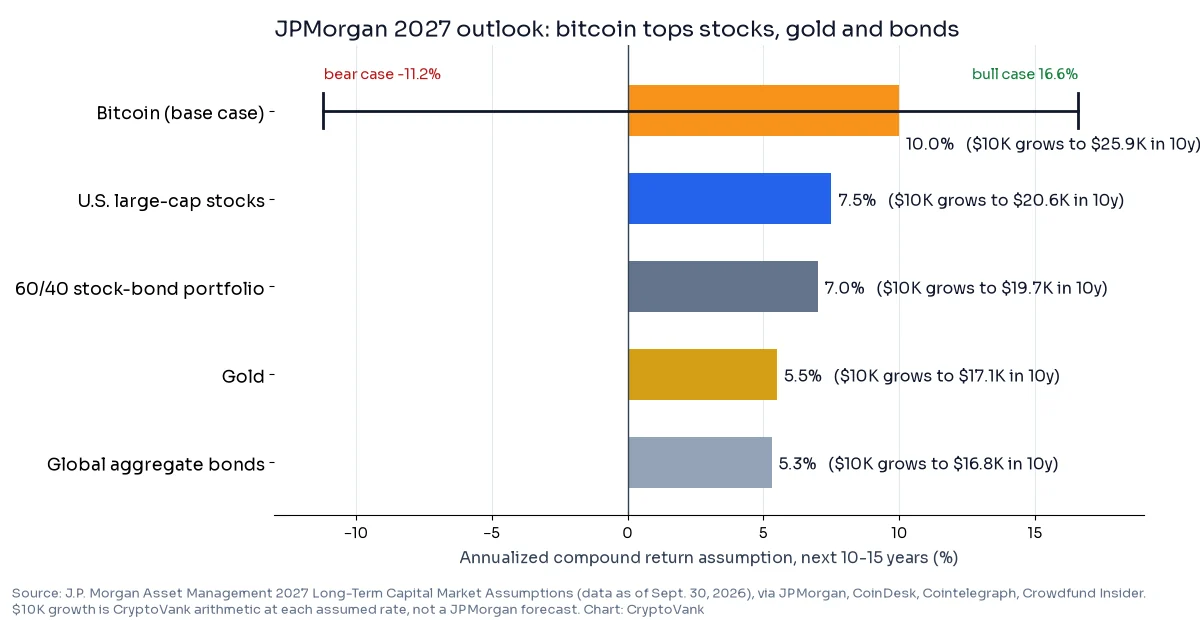
The 10% figure comes from three drivers, per Cointelegraph and Crowdfund Insider: bitcoin’s fixed supply versus money supply growth, a partial role next to gold, and network adoption. Crowdfund Insider reports weights of 65%, 30% and 5%.
The risk numbers matter just as much. JPMorgan assumes 55% annual volatility for bitcoin, against roughly 18% for U.S. large caps. That is why its arithmetic average return (20.9%) is about double the 10% compound return. Big drawdowns eat into what a holder actually keeps.
Here is our own math on those inputs. Per point of volatility, bitcoin’s base case earns about 0.18% of return. U.S. large caps earn about 0.42%. So the higher headline return comes with far more risk per dollar.
We also ran the bank’s rates forward from the $83,000 starting point. These are CryptoVank calculations, not JPMorgan price targets:
| Scenario (annual return) | BTC after 10 years | BTC after 15 years |
|---|---|---|
| Bear case (-11.2%) | ~$25,300 | ~$14,000 |
| Base case (10%) | ~$215,300 | ~$346,700 |
| Bull case (16.6%) | ~$385,500 | ~$830,900 |
The gap between those rows is the real message. A 10% average path still allows for a near-total collapse or a tenfold gain. Bitcoin traded at $81,832 at 13:58 UTC on Oct. 20, down 0.4% in 24 hours, per CoinGecko. That is a little below the report’s starting price.
How it fits JPMorgan’s crypto push
The forecast lands in a busy month for the bank. JPMorgan has just moved its JPM Coin deposit token onto Ethereum mainnet for institutional clients. Meanwhile, other big firms keep building bitcoin products, such as BlackRock’s PBIT buffer ETF filing and Switzerland’s first retail bitcoin ETF.
Each step makes it easier for advisers to take bitcoin seriously. A long-term return number from a top asset manager adds to that. Even so, a forecast is not a flow of money, and the market has been soft lately. October has been weak by bitcoin’s standards, as we covered in our look at back-to-back red Octobers.
What to watch next
- Next year’s edition. The key test is whether bitcoin moves into JPMorgan’s main covariance matrices. That would put it inside model portfolios, not just beside them.
- Volatility. The bank says lower volatility and steadier correlations could change its stance. Watch whether BTC’s swings keep shrinking.
- Other houses. Other big asset managers may follow with their own long-term bitcoin numbers.
- Price versus the path. Bitcoin needs to compound near 10% a year to stay on the base case. Starting from about $83,000, the base case implies roughly $100,000 by September 2028.
JPMorgan bitcoin forecast FAQ
What is the JPMorgan bitcoin forecast for the next decade?
JPMorgan Asset Management’s 2027 outlook, published Oct. 19, 2026, assumes bitcoin returns 10% a year in its base case over 10-15 years. That is above its 7.5% forecast for U.S. large-cap stocks and 5.5% for gold.
Does JPMorgan recommend buying bitcoin?
No. The report calls bitcoin a speculative asset and a hedge against monetary easing, not a diversifier. It also keeps bitcoin out of its main covariance matrices, so it is not part of the bank’s model portfolio allocations.
What price does a 10% annual return imply for bitcoin?
JPMorgan gave a return rate, not a price target. By CryptoVank’s math, 10% a year from the report’s Sept. 30, 2026, starting price of about $83,000 points to roughly $215,000 after 10 years. The bear case of -11.2% a year points to about $25,000.
Sources
- J.P. Morgan Asset Management: 2027 Long-Term Capital Market Assumptions
- CoinDesk: JPMorgan sees 10% annual bitcoin returns (Oct. 20, 2026)
- Cointelegraph via TradingView: JPMorgan projects Bitcoin to outperform US stocks and gold
- Crowdfund Insider: JPMorgan’s 2027 long-term outlook places bitcoin ahead of stocks, bonds and gold
- Yahoo Finance: JPMorgan’s 2027 LTCMA gives bitcoin a 10% return range
- CoinGecko: Bitcoin price
This article is for information only and is not financial advice. Crypto assets are volatile; do your own research before you invest.