Quick answer: Switzerland’s regulator FINMA approved the country’s first Swiss Bitcoin ETF for retail investors on Oct. 20, 2026. The fund holds bitcoin directly under Swiss fund law, with an exemption from diversification rules. FINMA did not name the issuer and said more providers have applied, per its press release.
The first Swiss Bitcoin ETF has the green light. On Oct. 20, 2026, the Swiss Financial Market Supervisory Authority FINMA said it had approved, for the first time, an exchange-traded retail fund that invests directly in bitcoin.
That puts Switzerland next to the US, where spot Bitcoin ETFs have traded since January 2024. However, the Swiss version comes with a clear warning from the regulator: the fund is regulated, but bitcoin is still very risky.
What did FINMA approve?
FINMA classified the product as an “other fund for alternative investments” with a specific risk under Swiss law. In plain terms, it is a regulated investment fund that ordinary investors can buy on an exchange, and it holds real bitcoin rather than futures.
Swiss fund rules normally force a fund to spread its money across many assets. FINMA made an exception here. It pointed to bitcoin’s long trading history and its “particularly high trading volume” compared with other cryptocurrencies.
Notably, the regulator did not name the fund. A FINMA spokesperson told The Block that it does not share institution-specific information. FINMA also said “other fund providers have also submitted or announced applications for Bitcoin ETFs.”
How is a Swiss Bitcoin ETF different from a bitcoin ETP?
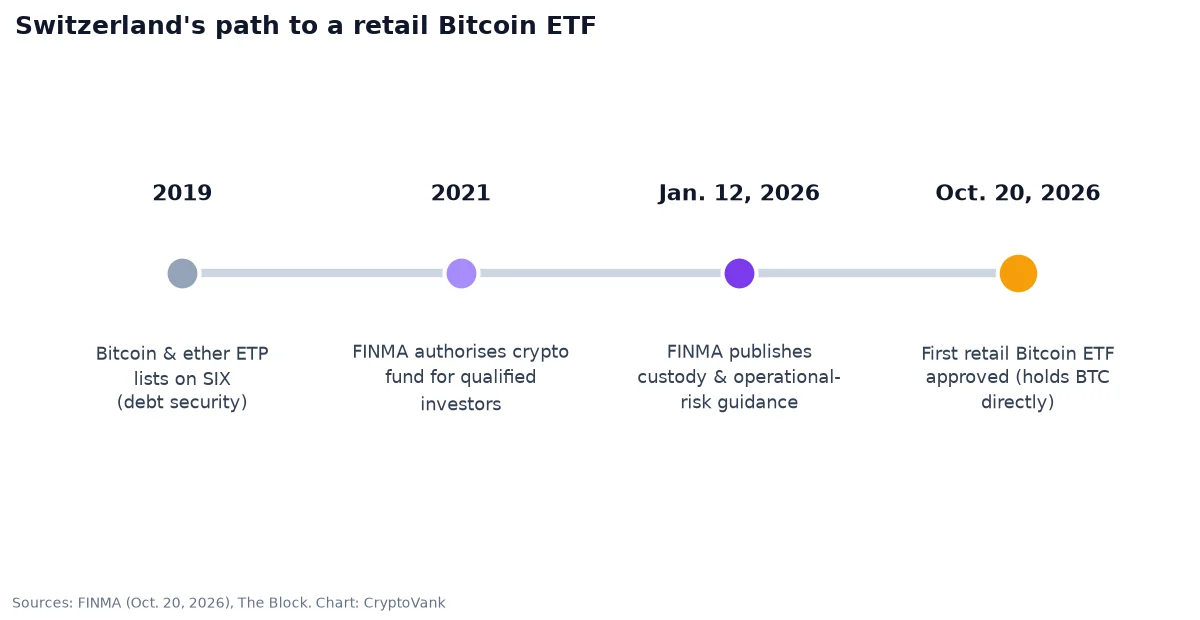
Switzerland is not new to crypto products. The SIX Swiss Exchange has listed bitcoin exchange-traded products (ETPs) for years, including a bitcoin and ether product launched in 2019, according to The Block. Still, those ETPs are debt securities, not investment funds.
| Feature | Existing Swiss bitcoin ETPs | New Swiss Bitcoin ETF |
|---|---|---|
| Legal form | Debt security | Investment fund under Swiss fund law |
| Approved for | Exchange trading | Retail investors |
| Custody rules | Set by each issuer | FINMA custody and operational-risk measures |
| Sales rules | FinSA rules apply | FinSA conduct and suitability rules stressed by FINMA |
As a result, the new ETF gives fund-only investors and advisers a way in. Many mandates can buy regulated funds but not debt notes linked to crypto. For a primer on how these products work, see our guide to how crypto ETFs work.
What safeguards come with the approval?
FINMA said supervised firms must reduce operational and custody risks, in line with guidance it published on Jan. 12, 2026. Sellers must also follow the Financial Services Act (FinSA) at the point of sale. That means clear warnings about volatility and losses, plus careful suitability checks.
Is the Swiss Bitcoin ETF safe for retail investors?
Not in the sense of protecting your money. FINMA was blunt: “investments in Bitcoin – even through an approved ETF – remain highly risky.” Because of bitcoin’s volatility, it warned, “the capital invested may lose a significant amount of its value.”
In other words, the approval covers how the fund is run, not where the price goes. Investors should size any position with that in mind.
What does it mean for the Bitcoin market?
In the short run, probably little. Bitcoin traded near $81,600 at about 12:55 UTC on Oct. 20, down roughly 1.1% in 24 hours, per CoinGecko. See our live Bitcoin price page for updates.
Over time, though, the move widens the regulated demand channel in Europe’s main private-banking hub. It also lands during a busy week for ETFs. BlackRock’s IBIT drew a $665 million inflow on Oct. 19, its largest since October 2025, The Block reported. Meanwhile, BlackRock also filed for a buffer Bitcoin ETF with a loss floor. You can follow US fund demand on our daily Bitcoin ETF flows tracker and read how to interpret ETF flows.
What should traders watch next?
- The issuer and ticker. The fund’s name, fees and listing date have not been announced yet.
- More approvals. FINMA confirmed other providers have applied, so a wave of Swiss Bitcoin ETFs is possible.
- Flows. Early trading volume will show whether Swiss advisers move clients from ETPs into the fund format.
Swiss Bitcoin ETF FAQ
When was the first Swiss Bitcoin ETF approved?
FINMA announced the approval on Oct. 20, 2026. It is the first exchange-traded retail fund in Switzerland that invests directly in bitcoin, according to the regulator’s press release.
Who is the issuer of the Swiss Bitcoin ETF?
The issuer has not been disclosed. A FINMA spokesperson told The Block on Oct. 20, 2026, that the regulator does not provide institution-specific information, so the name, ticker and fees are still unknown.
Can retail investors buy the Swiss Bitcoin ETF now?
Not yet, as no listing date has been published. Once it lists, investors will buy it through banks or brokers, which must apply FinSA rules, including risk warnings and suitability checks.
How is it different from a Swiss bitcoin ETP?
Swiss bitcoin ETPs are debt securities issued by a company. The new ETF is an investment fund under Swiss fund law, with FINMA-required custody and operational-risk safeguards, per FINMA and The Block.
Sources
- FINMA: FINMA approves Switzerland’s first Bitcoin ETF (Oct. 20, 2026)
- The Block: Swiss regulator FINMA approves country’s first spot bitcoin ETF for retail investors
- swissinfo.ch: Regulator green lights Switzerland’s first bitcoin ETF
- The Block: BlackRock’s IBIT draws $665 million inflow
- CoinGecko: Bitcoin price
This article is for information only and is not financial advice. Crypto assets are volatile; always do your own research (DYOR) before investing.