
Quick answer: The SoFi tokenized deposit, called SOFIE, launched on Oct. 22, 2026 and pays a variable 4.40% APY with FDIC insurance up to $250,000, per Cointelegraph and crypto.news. Each token equals $1 at SoFi Bank and converts 1:1 into the SoFiUSD stablecoin for crypto trades or transfers.
The SoFi tokenized deposit is live. On Thursday, SoFi launched SoFi Earn (SOFIE), a digital bank deposit that pays a variable 4.40% APY and carries FDIC insurance.
Each SOFIE token stands for $1 held at SoFi Bank, N.A., Cointelegraph reported. Holders can swap it one-for-one into SoFiUSD, the bank’s dollar stablecoin. Then they can buy crypto in the app or send funds to an outside wallet.
What happened with the SoFi tokenized deposit
SoFi announced the product on Oct. 22, 2026. There is no minimum balance. However, the rate is variable and can change at any time, and fees can cut earnings. SoFi’s disclosures set Oct. 20 as the reference date for the 4.40% rate, according to crypto.news.
Customers reach SOFIE through their SoFi Crypto account. It is a separate deposit account, and it is rolling out to SoFi Crypto members through November. Decrypt and The Block also reported the launch and the 4.4% yield.
SoFi calls SOFIE the first consumer tokenized deposit from a nationally chartered U.S. bank. CEO Anthony Noto framed it around idle cash. “We believe your money should keep working for you until the moment you need it,” he said, per crypto.news.
The setup has two layers:
- SOFIE is a bank deposit. It earns interest and has FDIC cover up to $250,000 per depositor, per bank, per ownership category.
- SoFiUSD is a payment stablecoin. It moves on blockchains around the clock, but it earns no deposit interest and has no FDIC insurance.
Why the SoFi tokenized deposit matters
The key point is legal, not technical. SoFi’s disclosure says SOFIE is a deposit liability and not a payment stablecoin. That label lets a bank pay interest. In contrast, the GENIUS Act bars payment stablecoin issuers from paying interest to holders.
So SoFi has split one dollar into two jobs. The deposit side earns yield while it waits. The stablecoin side moves when the user wants to trade. As a result, a customer no longer has to choose between interest and instant access to crypto.
The timing is also telling. On Wednesday, the Office of the Comptroller of the Currency issued its final rule on stablecoin issuance, and the GENIUS framework takes effect in mid-January, Cointelegraph noted. We covered that OCC rule when it landed. Meanwhile, the American Bankers Association has attacked the rule’s treatment of stablecoin rewards, The Block reported.
In other words, banks fear stablecoins draining their deposits. SoFi’s answer is to keep the money as a deposit until the last moment. Big banks have tried similar ideas for institutions, such as JPMorgan’s JPM Coin deposit token. SOFIE brings the model to retail users.
Data and context: how big is SoFiUSD?
SoFiUSD is still small. At 13:55 UTC on Oct. 22, its market cap was about $348 million, per CoinGecko. CoinGecko lists the token on Ethereum and Solana.
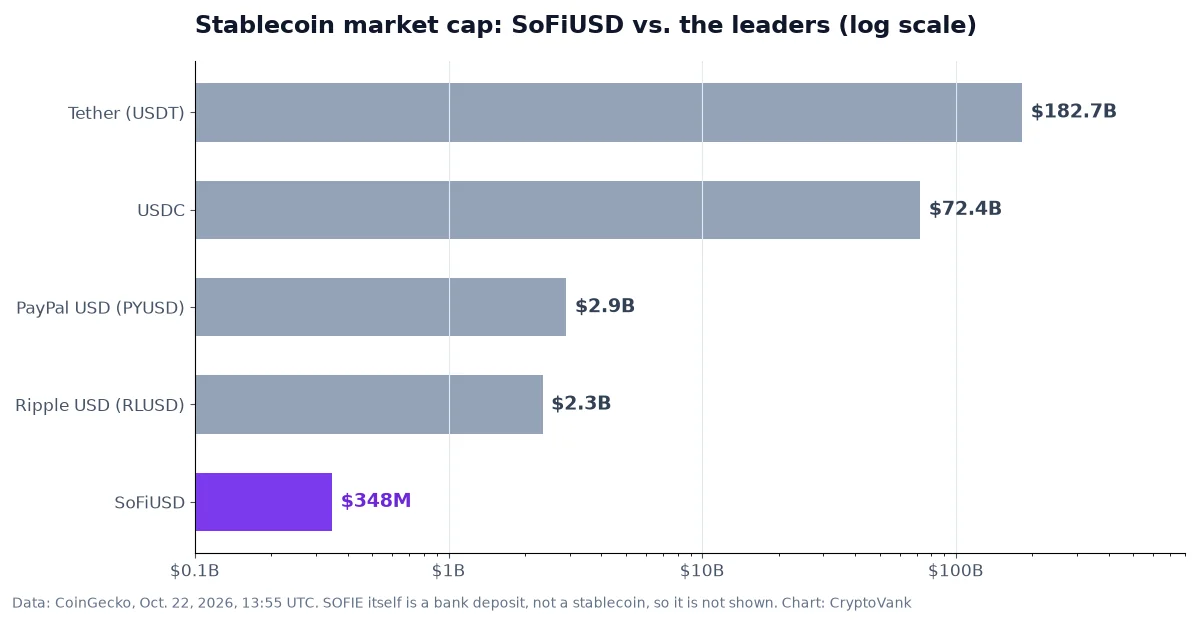
For scale, Tether’s USDT stood at $182.7 billion and USDC at $72.4 billion at the same time. PayPal USD was near $2.92 billion, and Ripple USD was about $2.35 billion. So SoFiUSD is roughly one-eighth the size of PayPal’s coin.
Still, SoFiUSD has grown. CoinGecko data show its market cap near $313 million in late August, up about 11% since then. A yield-bearing on-ramp could speed that up, because the deposit feeds the stablecoin.
The yield itself is easy to check. At an unchanged 4.40% APY, $5,000 would earn about $220 over a year before fees. By comparison, idle stablecoins in most exchange wallets earn nothing unless users opt into lending or staking products.
The launch also came on a weak market day. Bitcoin traded at $81,551, down 2.6% in 24 hours, and ether was at $2,405.70, down 2.7%, per CoinGecko at 13:56 UTC. That makes a safe place for idle cash more appealing to cautious traders.
What to watch next
First, watch the rate. The 4.40% APY is variable, so it will likely follow Federal Reserve moves. A lower rate would weaken the main selling point.
Next, watch the insurance line. The FDIC cover ends the moment a user converts SOFIE into SoFiUSD. Users should know which form their dollars sit in at any time.
Finally, watch rivals. If other chartered banks copy the model, the stablecoin rewards fight could shift from Congress to bank product shelves. For a non-bank way to spend stablecoins, see our crypto card comparison.
SoFi tokenized deposit FAQ
What is SOFIE?
SOFIE, or SoFi Earn, is a tokenized deposit launched by SoFi on Oct. 22, 2026. Each token equals $1 held at SoFi Bank, N.A., and it pays a variable 4.40% APY with no minimum balance.
Is the SoFi tokenized deposit FDIC-insured?
Yes. SOFIE deposits qualify for FDIC insurance up to $250,000 per depositor, per insured bank, for each ownership category. SoFiUSD, the stablecoin it converts into, is not FDIC-insured.
Who can use SOFIE?
SoFi Crypto members can access it through their SoFi Crypto account. SoFi said the product is rolling out to eligible members through November 2026.
Sources
- Cointelegraph: SoFi unveils bank-issued tokenized deposit for yield-bearing crypto funds
- crypto.news: SoFi launches SOFIE tokenized deposit offering 4.40% APY
- The Block: SoFi launches FDIC-insured tokenized deposit for crypto users
- Decrypt: SoFi launches tokenized deposit that earns 4.4%
- The Block: ABA accuses OCC over stablecoin rewards rule
- CoinGecko: SoFiUSD market data
This article is for information only and is not financial advice. Do your own research before you invest.