Quick answer: Yes. The Starknet layer 1 vote closed on Oct. 22, 2026 with 93.52% of voting power backing research into an independent, quantum-resistant chain, per Cointelegraph and crypto.news. The poll is non-binding: Starknet stays an Ethereum layer 2, and a draft whitepaper is due in November.
The Starknet layer 1 vote passed on Thursday, with 93.52% of voting power backing research into an independent, quantum-resistant blockchain. However, the poll does not move the network yet, and Starknet still runs as an Ethereum layer 2.
The seven-day poll closed on Oct. 22, 2026, after drawing about 3,200 votes, Cointelegraph reported. StarkWare said it was the highest turnout in Starknet governance history. The company also said it abstained, so STRK stakers and delegates made the call.
What happened in the Starknet layer 1 vote
StarkWare first floated the idea on Oct. 8. We covered that proposal at the time. Then, on Oct. 15, StarkWare opened the non-binding poll to STRK stakers and delegators.
In practice, voters had three options. They could support more research, oppose it, or stay neutral until more details came out, according to crypto.news. At first, support was near total. StarkWare’s own running tally showed 98.7% in favor on Oct. 21, so late ballots trimmed the final margin a little.
The result lets StarkWare and the Starknet Foundation spend real resources on the plan. The two groups have formed a working group. In addition, StarkWare CEO Eli Ben-Sasson told Cointelegraph the team hopes to publish a draft whitepaper “for public scrutiny in November.”
Three points from the proposal matter most for users:
- STRK stays the native token, and no new token is planned.
- The existing bridges between Starknet and Ethereum stay open.
- An actual move needs a separate, binding governance vote.
Why the Starknet layer 1 vote matters
The reason is quantum security, not fees or speed. Starknet’s own proofs already use hash-based STARK math, which is widely seen as safer against future quantum computers. Its accounts can also adopt new signature types, for example post-quantum ones.
The weak spots sit on Ethereum’s side. In its roadmap, StarkWare named two dependencies: bridge messaging and blob-based data availability. Ethereum secures blob data with KZG commitments, and some bridge functions use elliptic-curve cryptography. Therefore, a large enough quantum computer could in theory break both.
That creates a timing gap. Starknet targets full post-quantum security by 2027, while Ethereum’s target is 2029, Starknet said on X. Ben-Sasson put it bluntly: “Ethereum’s target of 2029 to become quantum-safe is too late, and deadlines slip.” As a result, an independent chain would let Starknet upgrade on its own schedule.
For Ethereum, this is a notable moment. After all, Starknet is one of the best-known zero-knowledge rollups. It is now openly asking whether the rollup model fits its security goals. Other layer 2 projects are also under strain this month, as our report on the Sophon chain shutdown showed.
STRK price data: the market sold the news
However, the token tells a different story from the vote count. At 10:49 UTC on Oct. 22, STRK traded at $0.0550, per CoinGecko. That was down 1.7% in 24 hours, with a market cap of about $418 million and $161 million in daily volume.
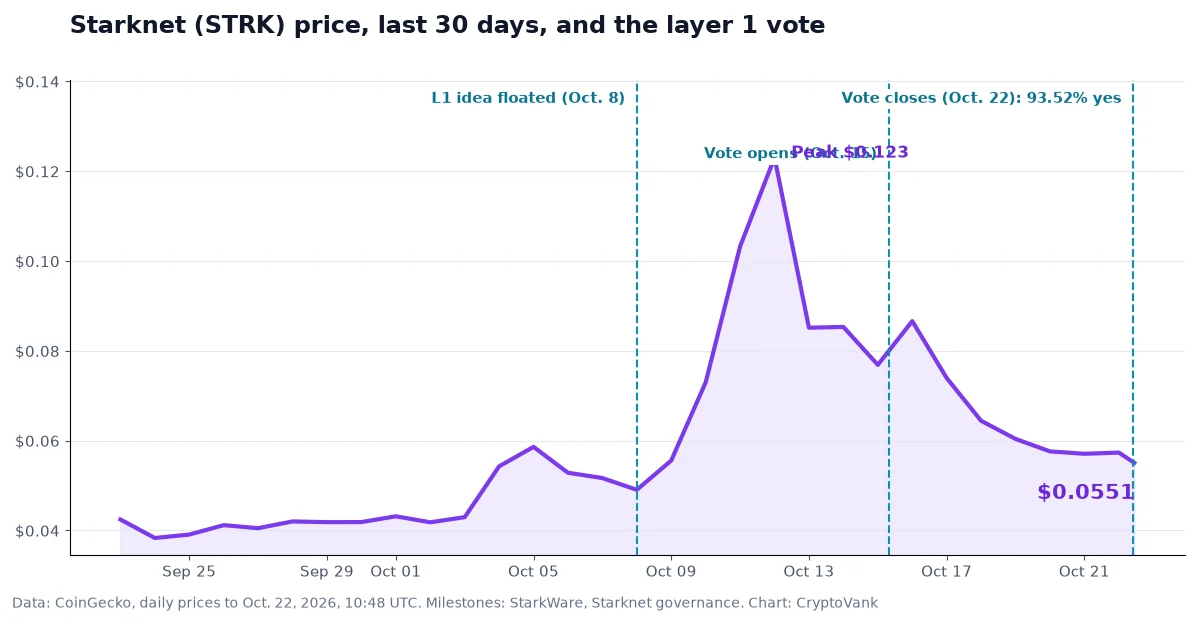
Still, the context matters. STRK rose from about $0.049 before the Oct. 8 proposal to a daily peak near $0.123 on Oct. 12, as our rally analysis tracked at the time. Since then, it has lost about 55%. It is also about 28% below its level when the poll opened on Oct. 15.
In other words, traders priced in the headline early and then took profits. A research vote with no deadline gives them little new to buy. Meanwhile, the wider market was weak too. Ether traded at $2,405 at the same time, down 2.0% on the day, and bitcoin was near $81,990.
What to watch after the Starknet layer 1 vote
The draft whitepaper is the next real test. Above all, it must answer how a standalone Starknet would secure itself. For instance, an independent chain would need its own validator set, its own data availability and a clear role for staked STRK. So far, no full replacement security model has been published, crypto.news noted.
Next, watch the bridge plan. The team says the bridges stay open, but it has not published how they would work under a separate chain. For holders, that detail matters more than the vote itself.
Finally, watch the second vote. After all, only a binding poll can approve a move. Until then, nothing changes for users, and no one needs to move funds. The wider quantum debate is also heating up across crypto, as our look at quantum-exposed bitcoin explains.
Starknet layer 1 vote FAQ
Is Starknet leaving Ethereum now?
No. The Oct. 22, 2026 poll only approved research into an independent layer 1. Starknet keeps running as an Ethereum layer 2, and any real move needs a separate, binding governance vote.
Do STRK holders need to do anything?
No action is needed today. The proposal says STRK stays the native token with no new token planned, and the bridges between Starknet and Ethereum stay open.
Why did the STRK price fall after a yes vote?
STRK had already rallied from about $0.049 to $0.123 between Oct. 8 and Oct. 12 on the idea itself, per CoinGecko. The non-binding result added little new, so traders took profits, and the token sat near $0.055 at 10:49 UTC on Oct. 22.
Sources
- Cointelegraph: Starknet voters back research into life beyond Ethereum
- crypto.news: Starknet’s proposed Ethereum exit wins 93.52% support
- The Block: Starknet community backs research into an independent post-quantum layer 1
- StarkWare on X: the non-binding vote opens
- Starknet on X: 2027 post-quantum target
- CoinGecko: Starknet (STRK) price data
This article is for information only and is not financial advice. Do your own research before you invest.