
Quick answer: Bitcoin fell to $81,366 at 16:55 UTC on Oct. 22, 2026, down 3.7% in 24 hours per CoinGecko, right on the Bitcoin ETF cost basis near $81,500 cited by Cointelegraph. The drop came even though the ETFs took in about $1.07 billion over three sessions, per Farside Investors.
Bitcoin is back at the average price paid by U.S. spot ETF buyers. The Bitcoin ETF cost basis sits near $81,500, and BTC traded at $81,366 at 16:55 UTC on Oct. 22, 2026, down 3.7% in 24 hours, according to CoinGecko.
The slide erased a run toward $85,000 from the day before. It also came after three straight days of heavy ETF buying, which shows that fresh money alone is not lifting the price.
What happened to Bitcoin on Oct. 22
The selling started in Asia. Mixed results from Tesla and Meta revived doubts about AI spending, and Chinese stocks entered a bear market, CoinDesk reported. South Korea’s Kospi lost 3.5% and Japan’s Nikkei 225 fell 2.7%.
Then U.S. trading added more pressure. President Donald Trump said the U.S. was “not negotiating” with Iran, and the Nasdaq Composite was down 2.3% shortly after the open, according to Cointelegraph. BTC hit $81,256 on Bitstamp at that point.
Altcoins fell harder. Ether traded at $2,383 at 16:55 UTC, down 5.1% on the day, per CoinGecko. CoinDesk’s DeFi index slid 5.6% earlier in the session, while futures liquidations jumped 52% to $431.1 million.
Why the Bitcoin ETF cost basis matters
The cost basis is the average price at which ETF investors bought their exposure. When BTC trades above it, the typical fund holder is in profit. When it slips below, that same holder is under water.
That line often acts as a psychological floor. Holders who are only slightly in profit tend to defend it. However, a clean break can turn buyers into sellers who want to exit at break-even.
This is why the level gets so much attention now. The funds hold about $100.8 billion in total net assets, Decrypt reported. A large share of that money is now close to flat.
The ETF flow data behind the move
The irony is that ETF demand has been strong this week. U.S. spot Bitcoin ETFs took in $526.7 million on Oct. 19, $23.2 million on Oct. 20 and $524.8 million on Oct. 21, according to Farside Investors. That adds up to about $1.07 billion in three sessions.
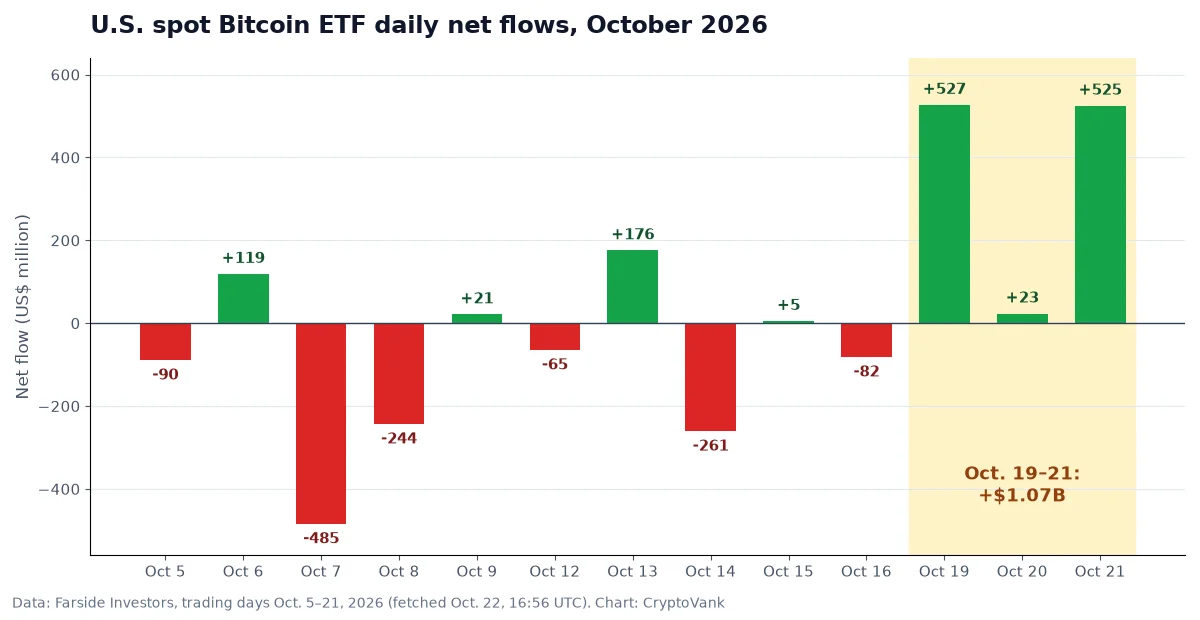
Monday’s inflow was the best day since Sept. 22, per Decrypt. As a result, October flows flipped from a loss of about $615 million to a gain of roughly $460 million. You can follow the daily numbers on our Bitcoin ETF flows tracker.
Still, price did not follow. In fact, CoinDesk noted that traders were mostly closing positions rather than opening new ones. Open interest fell 2.46% to $141.8 billion even as volume rose. In other words, the ETF bid is absorbing supply, but it is not yet strong enough to push BTC through resistance.
Meanwhile, institutions are widening their crypto access in other ways. For example, Grayscale’s in-kind transfers let investors move coins straight into ETF shares. Corporate treasuries also stay in focus after the proposed SpaceX-Tesla merger put a combined 30,221 BTC in the headlines.
What to watch next
First, the range. Analysts at Bitfinex Alpha expect BTC to trade between $81,300 and $84,400 until the Federal Reserve meets. They said a close below $81,300 would raise the risk of a move toward the Oct. 15 low of $79,821, per Cointelegraph.
Second, the Fed. Policymakers meet on Oct. 27–28. Decrypt noted that persistent inflation keeps another rate hike on the table, which would weigh on risk assets.
Third, the flows. If inflows keep arriving while price holds the cost basis, that would point to steady demand. Our view is simple: a daily close back above $84,400 with ETF buying intact would confirm the floor. On the other hand, a close below $79,821 would show that the cost basis has failed.
Finally, the betting markets are cautious. On Myriad, traders give BTC a 20% chance of topping $87,500 before October ends, Decrypt reported. Kalshi traders price only a 3% chance of a new all-time high by mid-January 2027, per Cointelegraph.
Bitcoin ETF cost basis FAQ
What is the Bitcoin ETF cost basis right now?
Cointelegraph put the average cost basis of U.S. spot Bitcoin ETF holders at about $81,500 on Oct. 22, 2026. Bitcoin traded at $81,366 at 16:55 UTC that day, per CoinGecko, so the typical ETF holder was roughly at break-even.
Why did Bitcoin fall even with $1 billion of ETF inflows?
Macro selling outweighed the ETF demand. AI spending doubts after Tesla and Meta results, a bear market in Chinese stocks and Trump’s comments on Iran pushed investors away from risk assets on Oct. 22, 2026, while derivatives traders closed positions.
What price levels are traders watching?
Bitfinex Alpha analysts flagged $84,400 as resistance and $81,300 as support until the Fed meeting on Oct. 27–28, 2026. A close below $81,300 could open a move toward the Oct. 15 low of $79,821, per Cointelegraph.
Sources
- Cointelegraph: Bitcoin circles $81.5K ETF cost basis as Trump Iran comments send stocks lower
- CoinDesk: Bitcoin slides below $82,000 as AI doubts return
- Decrypt: Bitcoin ETFs erase October losses with $1 billion in three days
- Farside Investors: Bitcoin ETF flow data
- CoinGecko: Bitcoin price
This article is for information only and is not financial advice. Crypto assets are volatile; do your own research.