
Quick answer: Bank Negara Malaysia and the Bank of Thailand joined Singapore’s BLOOM stablecoin initiative as policymaker members on Oct. 23, 2026, per the Monetary Authority of Singapore. Visa, Mastercard, Ripple, Maybank and the World Bank Group also joined. The group will set shared rules for settling stablecoins and tokenized deposits across borders.
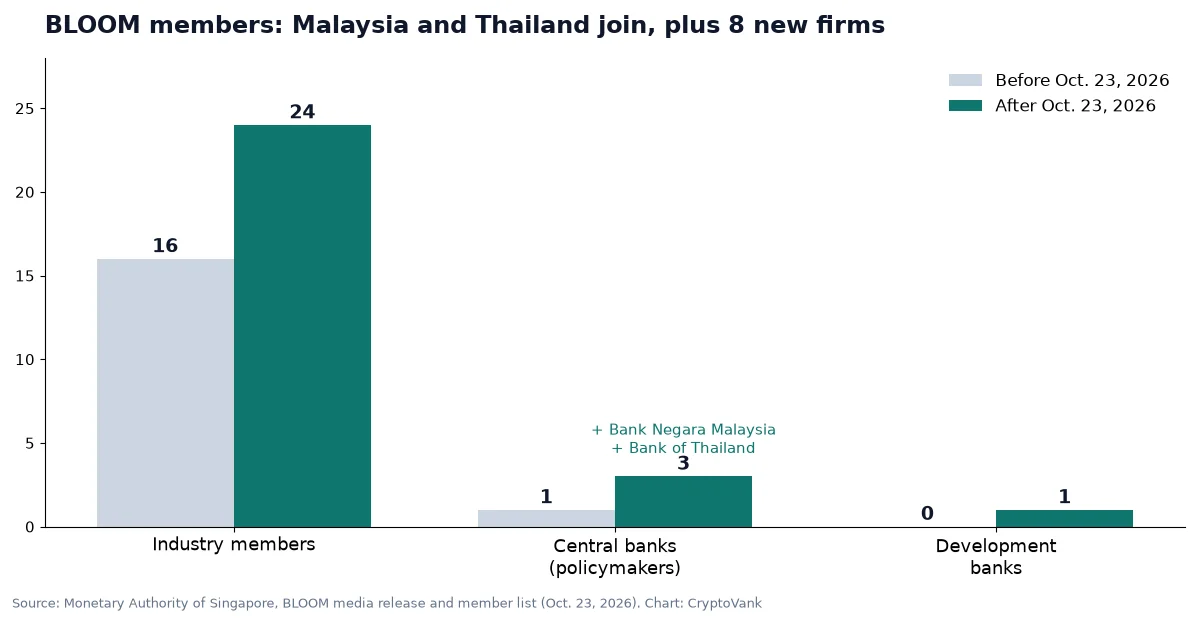
Singapore’s BLOOM stablecoin initiative now has three central banks at the table. On Oct. 23, 2026, the Monetary Authority of Singapore (MAS) said Bank Negara Malaysia (BNM) and the Bank of Thailand (BOT) joined as policymaker members, in a press release.
At the same time, eight firms joined the industry side: Airwallex, Mastercard, Maybank, Monee, Nium, Ripple, ShopeePay and Visa. The World Bank Group also signed on as a development bank. As a result, the project is no longer a Singapore test bed. It now looks like the start of a regional rulebook for digital money.
What happened with the BLOOM stablecoin project?
BLOOM stands for Borderless, Liquid, Open, Online, Multi-currency. MAS launched it in October 2025, building on Project Orchid, its 2021 work on a digital Singapore dollar, Cointelegraph reported.
In short, the goal is simple. Banks and payment firms want to settle trades with regulated stablecoins and tokenized deposits. Today, each firm must sign a separate deal with every partner and every market. BLOOM wants one shared framework instead, so firms can launch faster and spend less.
The 16 existing industry members include Circle, Coinbase, DBS, J.P. Morgan, OCBC, Standard Chartered, StraitsX, Stripe, Temasek and UOB, per the MAS member list. With the new names, BLOOM counts 24 industry members, three central banks and one development bank.
What will the members actually build?
MAS listed three work streams:
- Acceptance and settlement. How a bank in one country accepts digital money from another, how the two sides sign contracts and how the deal finally settles.
- Interoperability. How different token systems and networks can talk to each other across borders.
- Programmable controls. Checks built into the money itself, such as identity verification, sanctions screening and transaction limits.
Cointelegraph added that the work also covers corporate cash management, trade finance and payments made by AI agents within preset limits.
Why the BLOOM stablecoin move matters
First, it brings two of Singapore’s closest neighbors into the same room. Because so much trade moves between the three, shared settlement rules could cut real costs on regional invoices.
Second, the central banks get a say early. “The future of finance will involve multiple forms of digital money operating across different institutions and markets,” said Leong Sing Chiong, deputy managing director at MAS. BNM deputy governor Aznan Abdul Aziz said frictionless cross-border payments with “multiple digital monies” are “now closer to a tangible reality than a far-fetched fantasy.”
The Bank of Thailand was more careful. Deputy governor Daranee Saeju said the project lets the bank “carefully explore emerging innovations,” while keeping oversight “prudent, proportionate, and responsive to evolving risks,” The Edge Malaysia reported.
Third, the mix of members is telling. Card networks, a crypto exchange, a stablecoin issuer and big banks are all working on the same pipes. In our view, that points to a future where a bank deposit token and a regulated stablecoin settle side by side, rather than one model winning.
Data and context: the dollar still dominates
Still, the numbers show how early Asia’s local-currency tokens are. At 13:56 UTC on Oct. 23, 2026, CoinGecko put the total stablecoin market at about $297.6 billion. Tether (USDT) alone was worth about $182.5 billion and USD Coin (USDC) about $71.9 billion.
Together, those two dollar tokens make up roughly 85% of the market. By contrast, StraitsX’s XSGD, a Singapore dollar stablecoin from a BLOOM member, had a market cap of about $12.6 million. That is less than 0.01% of the total.
So BLOOM is not about replacing the dollar overnight. Instead, it is about giving banks a regulated way to move ringgit, baht and Singapore dollars on-chain, under rules all three central banks accept.
Moreover, the region is busy. On the same day, HSBC put its Hong Kong dollar token in front of millions of users, as we covered in our HSBC RedCoin report. Meanwhile, U.S. rules for issuers are now set, as explained in our story on the OCC’s GENIUS Act final rule.
What to watch next
- Pilot results. BNM said in February that three projects would test ringgit stablecoins and tokenized deposits in 2026, per Cointelegraph. Watch for links between those trials and BLOOM.
- More central banks. Other regional regulators could join, which would widen the network.
- Live products. Members such as Visa, Ripple and StraitsX may turn BLOOM work into real cross-border services.
- Rules on AI payments. Agent payments within set limits could become an early test case.
Finally, for everyday users, these changes will reach cards and wallets last. If you already spend crypto abroad, compare options in our crypto cards guide.
BLOOM stablecoin FAQ
What is the BLOOM stablecoin initiative?
BLOOM is a public-private project led by the Monetary Authority of Singapore. It sets shared rules for using regulated stablecoins and tokenized bank deposits in cross-border payments and settlement. MAS launched it in October 2025.
Who joined BLOOM on Oct. 23, 2026?
Bank Negara Malaysia and the Bank of Thailand joined as policymaker members. Airwallex, Mastercard, Maybank, Monee, Nium, Ripple, ShopeePay and Visa joined as industry members, and the World Bank Group joined as a development bank, per MAS.
Can retail users use BLOOM today?
No. BLOOM is a framework for banks, payment firms and regulators, not a consumer app or a token. Any benefit for retail users would come later, through products that members build on top of it.
Not financial advice. Stablecoins carry issuer, regulatory and operational risks. DYOR.
Sources
- MAS: MAS, BNM and BOT partner with industry on BLOOM (Oct. 23, 2026)
- MAS: BLOOM initiative page and member list
- Cointelegraph: Malaysia, Thailand join Singapore’s cross-border stablecoin push
- The Edge Malaysia: Malaysia, Thailand join Singapore’s Bloom digital money initiative
- The Block: Singapore, Malaysia and Thailand central banks expand cross-border stablecoin initiative
- CoinGecko: Stablecoins by market cap