Quick answer: Ethereum core developers postponed the Glamsterdam upgrade on the Hoodi testnet, set for Oct. 26, 2026, at 17:42:48 UTC, the Ethereum Foundation said on Oct. 22. ChainSecurity found that new gas rules in EIP-8037 and EIP-8038 could change how existing contracts handle failed calls. No new date is set.
Ethereum has hit pause on its next big upgrade. Core developers postponed the Glamsterdam upgrade on the Hoodi testnet, which was due on Oct. 26, 2026, at 17:42:48 UTC, after security researchers found that its new gas rules could change how live smart contracts handle failed calls.
The Ethereum Foundation confirmed the delay on Oct. 22. It said a new activation date has not been set.
What happened to the Glamsterdam upgrade?
Developers made the call on All Core Devs Execution call #248 on Thursday, Oct. 22. The goal is to study how EIP-8037 interacts with contracts already running on mainnet, the Foundation said.
The delay removes both halves of the fork on Hoodi. That covers the Amsterdam execution-layer changes and the Gloas consensus-layer changes. It also cancels a planned jump in Hoodi’s gas limit to 200 million at the same epoch. Hoodi’s chain history is not rolled back, though.
Node and validator operators on Hoodi must update their clients before Oct. 26. Besu 26.10.1, Nethermind 2.2.1 and Lodestar v1.50.1 already carry the change, per the Foundation’s release table. In contrast, mainnet users and ETH holders do not need to do anything.
Why did ChainSecurity flag the new gas rules?
The problem sits in two proposals. EIP-8037 changes how Ethereum charges for creating new state and adds a separate “state-gas reservoir.” EIP-8038 reprices state access. Both aim to keep the database in check as Ethereum raises throughput.
ChainSecurity laid out the risk in an Oct. 13 analysis. Many contracts catch a failed external call and then record the failure, skip a step or try a fallback. Some rely on the leftover gas being too small for that failure path to finish, so the whole transaction reverts instead.
Glamsterdam changes that math. When a called contract fails, gas it drew from the reservoir is restored to the caller. As a result, a failure handler that used to revert may now complete. An attacker could use this in an “insufficient gas griefing” attack. For example, a contract might permanently mark a user’s claim as failed, with no way to retry.
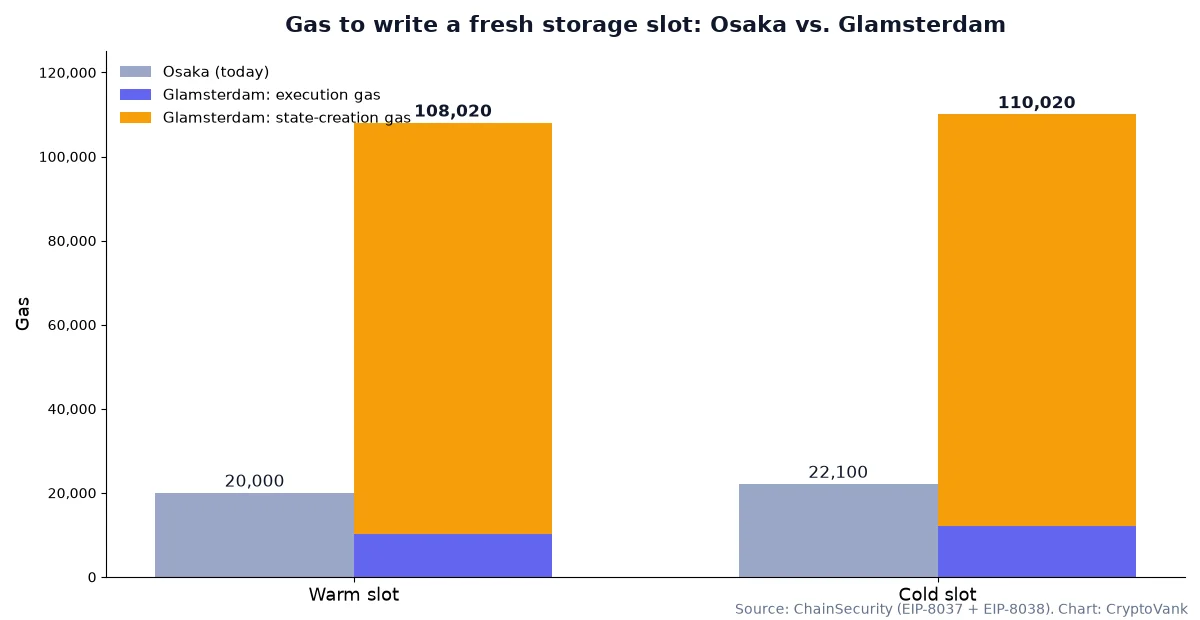
The risk also runs the other way. Creating a fresh storage slot can cost 110,020 gas once the reservoir is empty, versus 22,100 today, CoinDesk reported from ChainSecurity’s figures. So a contract with a fixed gas budget could fail on a valid action.
How serious is the risk for live contracts?
It is real but not yet proven at scale. ChainSecurity said on X that it had already found “13 real-world examples” and is in responsible disclosure with the affected projects. It has not named them.
The firm also stressed that not every gas check breaks. A correctly bounded check before a call still works. However, teams need to review any logic that assumes a set amount of gas will be left after a failure.
Our read: this delay is the testnet process working as intended. Sepolia already ran Glamsterdam on Oct. 6, and Hoodi exists to catch exactly this kind of issue before real money is at stake. Even so, it shows how hard it is to reprice state without touching old assumptions.
What the Glamsterdam delay means for ETH and the mainnet timeline
Glamsterdam is Ethereum’s main scaling upgrade after Fusaka. Its headline features are enshrined proposer-builder separation (EIP-7732) and block-level access lists (EIP-7928). Together, they let clients validate transactions in parallel and support a higher gas limit.
Developers had eyed early December for mainnet. An Oct. 15 proposal named Dec. 1 or Dec. 8, both tied to a clean Hoodi fork, ChainGate noted. Without a Hoodi date, those targets now look unlikely.
The market barely reacted. ETH traded at $2,398.83 at 07:53 UTC on Oct. 23, down 1.2% in 24 hours, per CoinGecko. That move tracks a wider risk-off day rather than the upgrade news. Demand was already soft, as our report on October’s Ether ETF outflows showed. You can follow the price on our Ethereum price page.
What to watch next
First, look for a new Hoodi date on the next core developer calls. Second, watch whether EIP-8037 is changed, delayed or kept as is. Third, check whether the 13 affected projects patch their contracts or publish post-mortems. Finally, the mainnet date will only firm up after Hoodi forks cleanly.
Ethereum’s layer-2 debate adds context too. Starknet just backed research into leaving Ethereum, as covered in our Starknet vote report. Meanwhile, banks keep building on Ethereum, such as JPMorgan’s JPM Coin move.
Glamsterdam upgrade FAQ
Why was the Glamsterdam upgrade delayed?
Developers postponed the Hoodi fork on Oct. 22, 2026, to study how EIP-8037 interacts with mainnet contracts. ChainSecurity showed the new gas rules could let failure handlers finish where they once reverted, or make valid writes run out of gas.
Do ETH holders need to do anything?
No. The Ethereum Foundation said no action is needed from mainnet users or ETH holders. Only Hoodi node and validator operators must update their execution and consensus clients before Oct. 26.
When will Glamsterdam go live on mainnet?
There is no date. Dec. 1 or Dec. 8, 2026, were proposed on Oct. 15, but both depended on a clean Hoodi fork. A new Hoodi date must come first.
Sources
- Ethereum Foundation: Glamsterdam on Hoodi Postponed
- Ethereum Foundation: Glamsterdam Hoodi Testnet Announcement
- ChainSecurity: Glamsterdam Hard Fork, When Spent Gas Comes Back
- ChainSecurity on X: 13 real-world examples
- CoinDesk: Ethereum delays Glamsterdam test
- Cointelegraph: Ethereum delays Glamsterdam Hoodi testnet launch
- ChainGate: Glamsterdam upgrade dates
- CoinGecko: Ethereum price
This article is for information only and is not financial advice. Crypto assets are volatile; do your own research (DYOR).