Quick answer: Zcash developers set the NU7 mainnet activation height at block 3,543,405, expected around Nov. 5, 2026, per Zakura. NU7 cuts block time from 75 to 25 seconds and sends 60% of fees to a reserve. ZEC traded at $1,271, up 12.4% in 24 hours, on CoinGecko at 07:57 UTC on Oct. 21.
Zcash NU7, the network’s next upgrade, finally has a mainnet date. Developers set the activation height at block 3,543,405, expected around Nov. 5, 2026, and ZEC jumped about 12% as traders priced in faster payments.
The move stands out on a quiet day. Bitcoin rose only 2% in the same window, according to CoinGecko.
What happened with Zcash NU7?
On Oct. 20, the ecosystem’s planned decision day, the teams confirmed the mainnet switch. Zakura, one of the Zcash node teams, posted at 22:29 UTC that the NU7 mainnet height “is being set to 3,543,405 (~November 5)” as part of final edits to ZIP 259, the upgrade’s deployment spec.
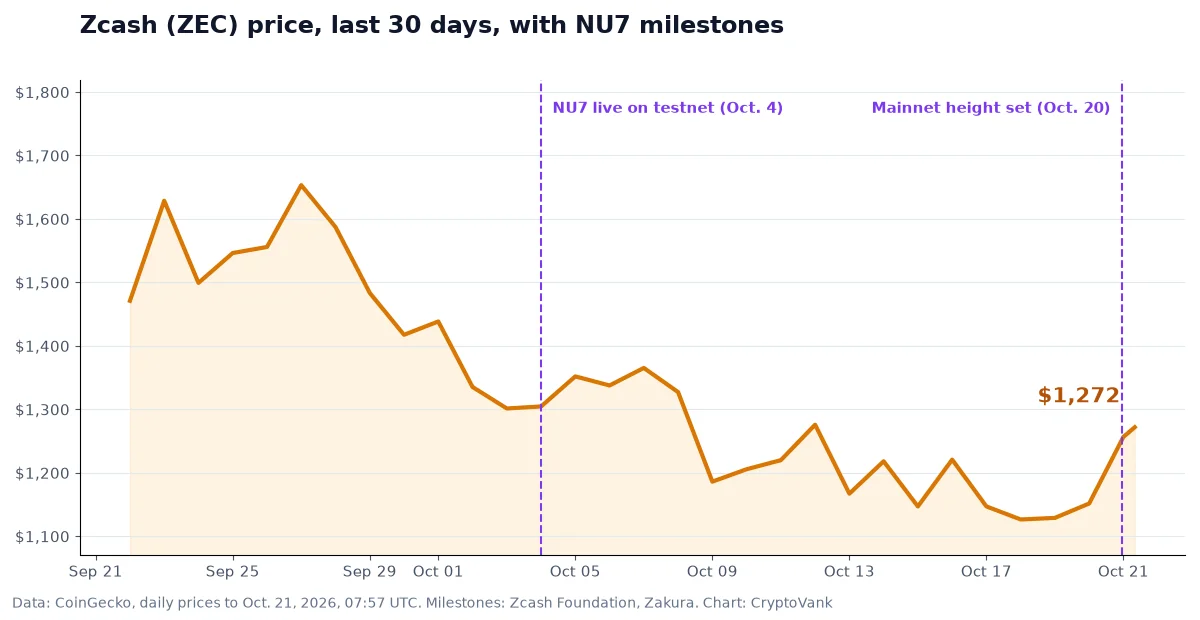
That ends a month of testing. NU7 went live on the public test network at block 4,465,026 on Oct. 4, per the Zcash Foundation’s engineering update. The NU7 timeline on the community forum had pencilled in Nov. 5 for mainnet since early October.
Prices reacted fast. ZEC led the large caps in Asian trading, rising 11% to about $1,260, CoinDesk reported. By 07:57 UTC on Oct. 21, CoinGecko showed $1,271, up 12.4% in 24 hours, with a market value near $21.6 billion.
What does the Zcash NU7 upgrade change?
NU7 bundles three main changes, according to ZIP 259.
- Faster blocks: the target time between blocks falls from 75 seconds to 25 seconds. As a result, payments should confirm about three times faster.
- Fee reserve: 60% of transaction fees leave circulation and go into a reserve called the Network Sustainability Mechanism. Miners keep the other 40%.
- Old formats retired: version 4 transactions become invalid. Because Sprout, Zcash’s oldest privacy pool, can only use that format, any funds left there become unspendable.
The upgrade also adds limits on shielded activity per block to protect light wallets from spam, the Zcash Foundation says.
Faster blocks do not mean faster inflation. The reward per block drops to one third, so daily issuance stays on schedule, CoinDesk explained. ZIP 259 also states the changes do not raise the supply cap. Reserve payouts to miners are set to begin in February 2031, per the forum timeline.
Why does it matter for ZEC holders?
The short answer is usability and security budget. Today a Zcash payment needs more than a minute for one confirmation. At 25 seconds, the coin feels closer to a payments network. That matters for a privacy asset that wants everyday use, not just storage.
The fee reserve targets a slower problem. Like Bitcoin, Zcash pays miners mostly with new coins, and that subsidy keeps shrinking. Recycling fees into future rewards gives miners a second income source over the long run.
However, the rally needs context. ZEC was near $1,471 a month ago and bottomed at about $1,126 on Oct. 18, per CoinGecko. So even after this jump, it still sits roughly 14% lower than 30 days ago.
The privacy trade is also not moving as one. Monero fell 4.3% to about $586 over the same 24 hours, CoinGecko shows. For background, see our look at Monero’s push toward $600 and the Pirate Chain exploit, a reminder that privacy coins carry their own risks.
What to watch before Nov. 5
First, node upgrades. Mainnet operators must install the stable NU7 release before Zebra 6.4.x stops in early November, the Zcash Foundation says. ZIP 259 warns that unsupported software could stay online and follow an old chain, so exchanges will want clear upgrade notices.
Second, Sprout balances. Anyone with coins in that old pool needs to move them before activation.
Third, the market setup. Rallies built on an upgrade date can fade once it passes, so traders will watch whether ZEC holds above $1,200 into the switch. Meanwhile, Solana is set to switch on its own consensus overhaul later today, which we covered in our Solana Alpenglow explainer.
Zcash NU7 FAQ
When does Zcash NU7 activate on mainnet?
NU7 activates at block 3,543,405, which Zakura expects around Nov. 5, 2026. The exact time depends on how fast blocks arrive, so operators should track the block height rather than the calendar date.
Do ZEC holders need to do anything for NU7?
Most holders do not. NU7 adds no new transaction format, so wallets should work as before. However, anyone with funds in the old Sprout pool should move them before activation, because those coins become unspendable afterwards under ZIP 259.
Does NU7 change the ZEC supply?
No. ZIP 259 says the changes do not raise the supply cap. Block rewards drop to one third to match the faster 25-second blocks, and 60% of fees go into a reserve that pays miners later.
Not financial advice. Crypto assets are volatile, so do your own research (DYOR) before making any decision.
Sources
- Zakura on X: NU7 mainnet activation height (Oct. 20, 2026)
- ZIP 259: Deployment of the NU7 Network Upgrade
- Zcash Foundation engineering update, Sept. 21 to Oct. 5, 2026
- Zcash Community Forum: NU7 Timeline
- CoinDesk: Bitcoin hovers around $83,000, ZEC jumps 11% (Oct. 21, 2026)
- CoinDesk: Zcash’s 25-second blocks go live on public testnet (Oct. 5, 2026)
- CoinGecko: Zcash price