
Quick answer: Uber used HSBC tokenized deposits to buy shares of a Franklin Templeton tokenized money market fund on Tradeweb, settled on the Canton Network through Fireblocks. It sold part of the position over a weekend, earning yield on cash that would normally sit idle until Monday. It is a pilot, and the amount was not disclosed.
Uber tokenized deposits just did something a corporate treasury normally can’t: sell a money market fund on a Sunday and have the cash back the same day. The pilot is small and the size is secret, but the setup behind it shows where big-company cash management is heading.
What happened with the Uber tokenized deposits pilot
On Oct. 30, 2026, HSBC Bank USA, Franklin Templeton, Tradeweb Markets and Fireblocks announced a completed pilot with Uber as the client, according to the Canton Network press release, also published by Tradeweb.
The flow worked like this. Uber held HSBC Tokenized Deposits, which are regular bank deposits recorded as tokens. It used them to buy shares of a Franklin Templeton tokenized money market fund on Tradeweb. Fireblocks provided the wallets, and the trade settled on the Canton Network as delivery-versus-payment, so the fund shares and the cash moved at the same moment.
Uber then sold part of the holding, including over a weekend. Bloomberg reported that Uber bought on a Thursday and sold on a Sunday, which gave it about 1.5 more days of yield than selling on Friday. The investment amount was not disclosed.
“This pilot is an important first step in our journey towards a more efficient, 24/7 model for managing our working capital,” said Odette Rodrigues, Uber’s vice president for corporate finance, treasury and capital markets, in the release.
Why Uber tokenized deposits matter for corporate cash
Large companies pay people and suppliers every day, including weekends. Banks and funds don’t settle on weekends, and fund trades usually settle the next business day or later. So treasurers keep a buffer of cash that earns little or nothing, just to cover payments that land between Friday evening and Monday morning. CoinDesk described this idle buffer as the core problem the test was trying to solve.
If a fund can be sold at any hour and the cash arrives at once, that buffer can stay invested longer. The release lists the pieces that make it work. They include yield that never switches off, atomic settlement, no public bridges between networks, and privacy through a Canton sub-net. Cash can also only flow back to KYC-verified corporate accounts.
Two details stand out. First, HSBC says its tokenized deposits remain deposit liabilities that are FDIC-insured up to the usual limits. That is a different legal product from a stablecoin, which is issued by a separate company and backed by reserves. Second, Uber did not need to hold any crypto token to take part.
Data and context: how much is weekend yield worth?
Uber did not share numbers, so here is a purely hypothetical example. It is not Uber’s figure. Suppose a company parks $100 million in a fund yielding 3.75%, the low end of the Fed range after the October Fed decision. An extra 1.5 days of yield is worth about $15,400 ($100M × 3.75% × 1.5 ÷ 365).
That sounds small. But a large company might do it every weekend, across billions of dollars of operating cash. The real gain is the smaller buffer, since cash that no longer needs to sit idle can earn yield all week.
This is not the first test of its kind. JPMorgan has moved tokenized money market funds onto Solana, and SoFi launched a tokenized deposit product. Canton itself already carries real securities through the DTCC tokenization service. Franklin Templeton, which reported $1.79 trillion in assets under management as of Sept. 30, 2026, also runs its Benji platform on other chains, as seen in its XRP Ledger fund launch.
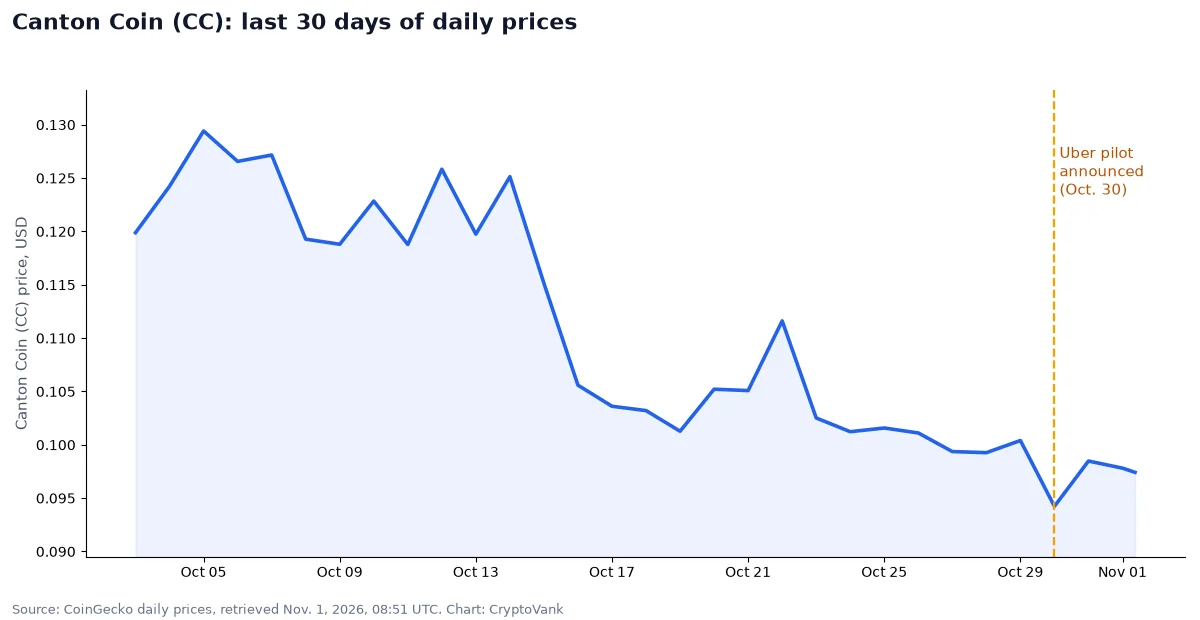
Markets were calm when we checked. CoinGecko showed Canton Coin (CC) at $0.0974 at 08:51 UTC on Nov. 1, 2026, up 1.3% in 24 hours and ranked 28th with a market value of about $3.9 billion. Bitcoin traded at $78,095 and Ether at $2,273. Over 30 days, CC is still down about 19%, so the pilot news has not reversed its slide.
What to watch next
Bloomberg reported that the participants expect more companies to adopt the setup. The key questions are scale and repeat use. A one-off weekend trade proves the plumbing works. Regular weekly use by several treasuries would show that it saves real money.
Watch for three things. One is whether HSBC opens the service to more corporate clients. Another is whether other banks link their own deposit tokens to Canton. The last is whether regulators treat tokenized deposits differently from stablecoins as rules develop. Also note what the pilot did not show, which is the trade size, the costs of running it, and how it would hold up under stress.
For now, the Uber tokenized deposits test is a working proof of concept, not a product launch.
FAQ
What are Uber tokenized deposits?
They are HSBC bank deposits held by Uber and recorded as digital tokens. HSBC says they remain normal deposit liabilities, FDIC-insured up to the usual limits, so they are not a stablecoin or a crypto asset.
Did Uber buy crypto in this pilot?
No. Uber bought shares of a Franklin Templeton tokenized money market fund with tokenized bank deposits. The trade used the Canton Network for settlement, but Uber did not need to buy a crypto token.
Why does weekend settlement matter?
Banks and funds normally settle only on business days. Selling a fund on a Sunday and getting cash right away lets a company keep more money invested, instead of holding a large idle buffer for weekend payments.
Sources
- Canton Network press release, Oct. 30, 2026
- Bloomberg: Uber joins HSBC, Franklin Templeton in blockchain investing test
- CoinDesk: Uber tests how tokenization can put idle cash to work
- CoinGecko: Canton Coin price
This article is for information only and is not financial advice.