
Quick answer: Franklin Templeton filed final SEC paperwork on Oct. 22, 2026, for its Franklin Templeton Bitcoin DRIP ETFs, FBEQ (0.09% fee) and FIBT (0.19%), which start at 95% U.S. stocks and 5% bitcoin and reinvest every dividend into bitcoin, per the funds’ prospectus. The prospectus takes effect on Oct. 27, 2026.
Franklin Templeton wants to turn the dividends of America’s biggest companies into a steady bitcoin buy. The asset manager filed a Form 8-A with the SEC on Oct. 22, 2026, registering two new funds for trading on Nasdaq, and an updated prospectus the same day set an effective date of Oct. 27, 2026.
The Franklin Templeton Bitcoin DRIP funds are the Franklin US Equity Bitcoin DRIP Index ETF (FBEQ) and the Franklin US Innovation Bitcoin DRIP Index ETF (FIBT). They are stock funds with a small bitcoin sleeve that grows only when the companies inside pay dividends.
What are the Franklin Templeton Bitcoin DRIP ETFs?
A DRIP, or dividend reinvestment plan, normally buys more shares of the company that paid you. These funds, however, send the cash somewhere else. According to the prospectus, “all regular and special dividends are reinvested into bitcoin at the market open on the day following the dividend ex-date.”
Both funds track indexes run by VettaFi:
| FBEQ | FIBT | |
|---|---|---|
| Index | VettaFi US Large-Cap 500 Bitcoin DRIP Index | VettaFi US Innovation 100 Bitcoin DRIP Index |
| Stocks | 500 largest U.S. companies (499 on Sep. 30, 2026) | 100 largest non-financial Nasdaq firms |
| Bitcoin at start | 5% | 5% |
| Annual fee | 0.09% | 0.19% |
| Exchange | Nasdaq | Nasdaq |
The 500-stock index held companies worth between $10.2 billion and $5.5 trillion on Sep. 30, 2026, per the filing. The index prices bitcoin with the Kaiko Bitcoin New York Reference Rate at 4:00 p.m. Eastern time.
How does the bitcoin allocation work?
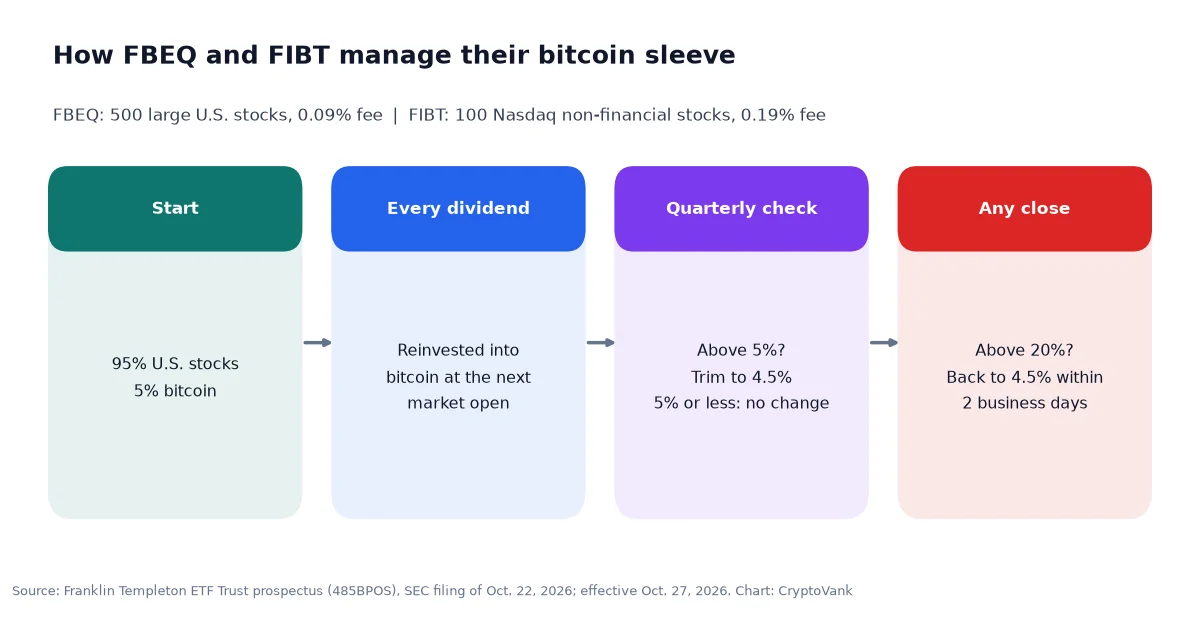
However, the bitcoin part does not ride freely. The prospectus sets two limits:
- Quarterly check: if bitcoin is above 5% at a rebalance, it is cut back to 4.5%. At 5% or below, nothing changes and there is no top-up.
- Hard ceiling: if bitcoin tops 20% at any close between rebalances, it goes back to 4.5% at the close of the second business day after.
In plain terms, a holder gets a mostly-stock fund that buys a little bitcoin every time a dividend lands, with profits from a big rally pushed back into stocks. On the other hand, when bitcoin falls, only new dividends refill the sleeve.
Do the funds hold real bitcoin?
No. The funds get exposure through bitcoin exchange-traded products, including ones sponsored by Franklin affiliates, as well as bitcoin futures, options and depositary receipts. Some of that can sit in a wholly owned Cayman Islands subsidiary, the filing says. As a result, investors never touch a wallet or an exchange account.
Franklin also agreed to waive part of its management fee equal to the sponsor fees its affiliates earn on assets the funds place in their own bitcoin products, which keeps holders from paying a full second layer of fees on that exposure.
Why does this matter for the bitcoin market?
The launch lands at a soft moment. Spot bitcoin ETFs just logged their biggest outflow since June, and bitcoin traded near $80,600 on Oct. 24, 2026, per CoinGecko. Check the live bitcoin price and daily Bitcoin ETF flows for the latest.
Still, the bigger story is distribution. A 5% bitcoin slice inside a cheap S&P-style fund reaches savers who would never buy a pure crypto ETF. It follows other attempts to package bitcoin for cautious buyers, like BlackRock’s buffered bitcoin ETF and Schwab’s move to offer crypto to all clients.
The buying is small and slow, though. That’s because flows depend on assets raised and on dividend dates, so the funds will not move the price on day one. New to the format? Our guide on how crypto ETFs work covers the basics.
Franklin Templeton Bitcoin DRIP FAQ
When do FBEQ and FIBT start trading?
The prospectus filed on Oct. 22, 2026, becomes effective on Oct. 27, 2026, and the Form 8-A registered both funds on Nasdaq. Trading can begin once the funds launch; Franklin Templeton has not announced a separate first-trade date.
How much bitcoin do the Franklin Bitcoin DRIP ETFs hold?
Each index starts at 5% bitcoin and 95% stocks. Dividends then add to the bitcoin sleeve, which is trimmed to 4.5% if it is above 5% at a quarterly rebalance or above 20% at any close.
What fees do FBEQ and FIBT charge?
FBEQ charges 0.09% a year and FIBT charges 0.19% a year, with no 12b-1 fee, per the prospectus. Franklin waives part of the fee to offset sponsor fees earned on its own bitcoin products held by the funds.
Is a Bitcoin DRIP ETF safer than a spot bitcoin ETF?
It carries less bitcoin risk because most of the money sits in large U.S. stocks and the bitcoin share is capped. It still carries full stock-market risk, and the bitcoin sleeve can lose value quickly.
This article is for information only and is not financial advice. Crypto and ETFs carry risk; DYOR before investing.




1 comment