Quick answer: Datavault AI bitcoin from Scilex’s $150 million share purchase has been stuck on the Biconomy exchange since June 2026, per an SEC filing on Oct. 26, 2026. Datavault will restate more than a year of results, and its stock fell 49.6% to about $0.067 on Oct. 27.
Datavault AI bitcoin that the company booked as an asset is stuck on a crypto exchange, and the stock has halved. Datavault AI (DVLT) told the SEC on Oct. 26, 2026 that it has not been able to withdraw bitcoin from its Biconomy account since June. As a result, it will restate more than a year of financial results.
Shares closed near $0.067 on Tuesday, Oct. 27, down 49.6% from $0.133, per The Block. Trading volume was about eight times the prior session.
What happened to Datavault AI’s bitcoin?
The story starts with a deal signed on Sept. 25, 2025. According to the Form 8-K, Scilex Holding agreed to buy 15 million Datavault shares and a pre-funded warrant for 263.9 million more. The price was $150 million, payable in bitcoin at $112,915.52 per coin, or about 1,328.43 BTC.
However, the coins never moved on the Bitcoin blockchain. Instead, Scilex credited 1,309.04 BTC to Datavault’s account at Biconomy Pte. Ltd. through off-chain transfers on Sept. 26 and Nov. 25, 2025. The 19.39 BTC gap reflects cash advances Scilex made before closing.
Then, between Sept. 26, 2025 and Jan. 30, 2026, Datavault sold 491.431 BTC back to Scilex for about $40.5 million in cash. In June 2026, it asked Biconomy to send bitcoin to an outside wallet. As of the filing, that withdrawal still had not gone through. The filing does not explain why.
Why the accounting change matters
Datavault’s audit committee concluded on Oct. 20 that four sets of results can no longer be relied on. These include the 2025 annual report and three quarterly reports.
The company now says the bitcoin did not qualify as its own digital asset. Instead, it will record a “subscription receivable”, which is money Scilex still owes for the shares. That amount reduces shareholders’ equity rather than adding to assets. The filing also says crypto gains and losses linked to the coins will be reversed.
This is more than a bookkeeping fix. Datavault had counted those bitcoin balances as a source of cash when it judged whether it could keep operating. Now management is reassessing that going-concern view, because collecting from Scilex “is uncertain”, in the filing’s words.
The numbers behind the drop
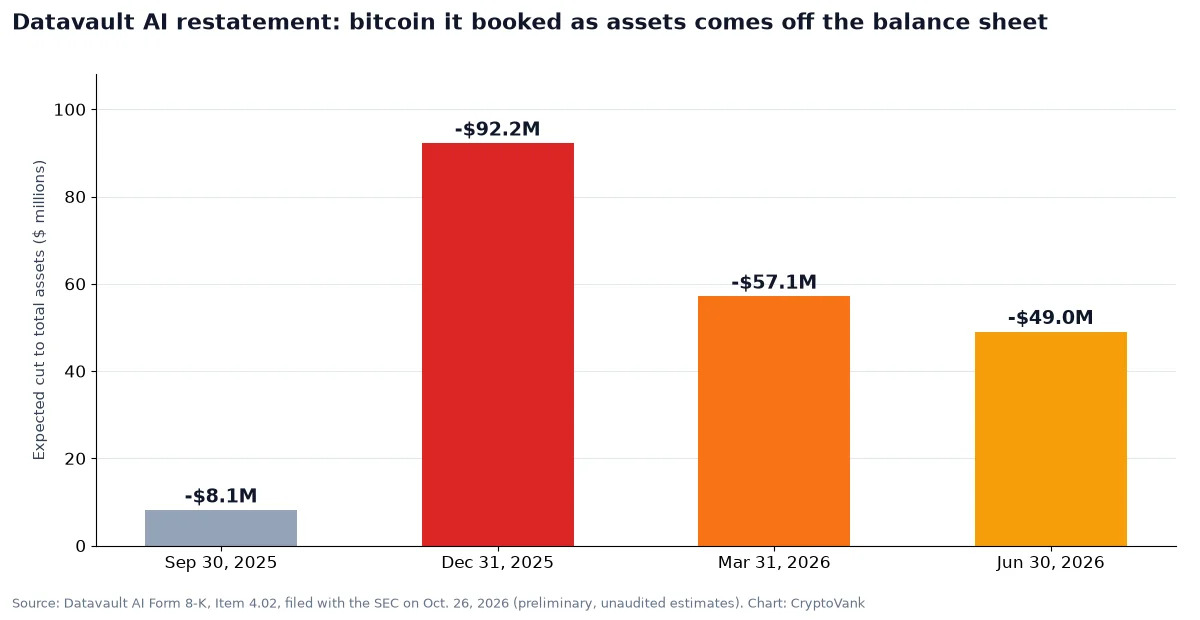
The 8-K says the restatement will cut total assets by $8.1 million at Sept. 30, 2025 and $92.2 million at Dec. 31, 2025. The cut is $57.1 million at March 31, 2026 and $49.0 million at June 30, 2026. These figures are preliminary and unaudited.
Our own math adds context. On paper, 1,309.04 credited BTC minus 491.431 BTC sold leaves about 817.6 BTC. At CoinGecko’s price of $80,945 at 07:55 UTC on Oct. 28, 2026, that is roughly $66.2 million. The filing does not state the current account balance, so treat this as an estimate.
The resale price also stands out. Selling 491.431 BTC for about $40.5 million implies roughly $82,400 per coin. That is far below the $112,915.52 rate used to price the shares. Meanwhile, bitcoin itself is down about 28% from that deal rate.
Biconomy’s role runs deeper than custody. CoinDesk reported that Scilex’s June financial report shows it sold $200 million of shares in its unit Semnur to Biconomy for bitcoin. Scilex then used $150 million of that to buy the Datavault securities. CoinDesk said Biconomy had not responded to its questions.
Lessons for bitcoin treasury investors
Corporate bitcoin buyers usually stress that they hold real coins. This case shows why the details matter. An exchange balance credited off-chain is only a claim on that exchange. It is not the same as coins in a wallet the company controls.
Other treasury firms take a different path. For example, Strive’s recent 6,182 BTC purchase and the bitcoin preferred-stock trend both rely on disclosed holdings that investors can track. Exchange risk is also not new. The CoinDCX loss of $15.99 million in USDT is a recent reminder that funds left on a platform depend on that platform.
What to watch next
First, watch for restated filings. Datavault has not set a date, and it warned it may find more errors. Second, look for any statement from Biconomy or Scilex on the stuck withdrawal. Third, watch the going-concern review, which could change how investors value the company.
Finally, the broader market is calm. Bitcoin rose 1.5% over 24 hours to about $80,945, per CoinGecko, ahead of the Fed’s rate decision on Oct. 28. So this is a company-specific blow-up, not a sign of wider stress. For the bigger picture, see our take on whether the bitcoin bear market is over.
Datavault AI bitcoin FAQ
Why can’t Datavault AI withdraw its bitcoin?
Datavault says it asked Biconomy in June 2026 to move bitcoin to an external account and the withdrawal is still incomplete. Its Oct. 26, 2026 SEC filing gives no reason for the delay.
How much bitcoin is involved?
Scilex credited 1,309.04 BTC to Datavault’s Biconomy account in 2025, and Datavault sold 491.431 BTC back for about $40.5 million. That leaves roughly 817.6 BTC on paper, worth about $66 million at Oct. 28 prices, per CoinGecko.
Is Datavault AI still a going concern?
The company has not decided. Management is reassessing its going-concern evaluation for 2025 and the first quarter of 2026, because it no longer counts the bitcoin as an asset and collecting from Scilex is uncertain.
Sources
- Datavault AI Form 8-K, Item 4.02 (SEC, filed Oct. 26, 2026)
- CoinDesk: Bitcoin treasury Datavault AI plunges 50% after firm says it can’t access its BTC
- The Block: Datavault AI stock plummets 50% after firm says it cannot withdraw bitcoin
- CoinGecko: Bitcoin price
This article is for information only and is not financial advice. Always do your own research.