
Quick answer: Bitcoin preferred stock has financed 135,979 BTC through Oct. 5, 2026, according to Fidelity Digital Assets. That is about 0.65% of bitcoin’s 21 million supply. The model only works while BTC rises faster than the dividends, and Strategy’s latest week, with $193 million of STRC buybacks against 267 BTC bought, shows the strain.
Bitcoin preferred stock has quietly become one of the biggest buyers of BTC, funding 135,979 coins through Oct. 5, 2026, according to new research from Fidelity Digital Assets. But with bitcoin stuck near $80,000, the dividends behind that buying are starting to compete with the buying itself.
At 07:53 UTC on Oct. 25, CoinGecko priced BTC at $80,621, roughly flat over 24 hours. At that price, the coins bought with preferred money are worth about $11 billion.
What happened with bitcoin preferred stock?
On Tuesday, Oct. 20, Fidelity Digital Assets called perpetual preferred stock “the newest demand catalyst” for bitcoin. The idea is simple. A company sells shares that pay a fixed or variable dividend and never mature. Then it uses the cash to buy BTC.
According to the report, as covered by crypto.news and Crypto Briefing, this channel financed 135,979 BTC through Oct. 5. Most of it came in a burst. Between March and May 2026, issuers raised more than $7 billion and bought more than 95,000 BTC. April alone accounted for more than 48,000 BTC, including nearly 30,000 in a single week.
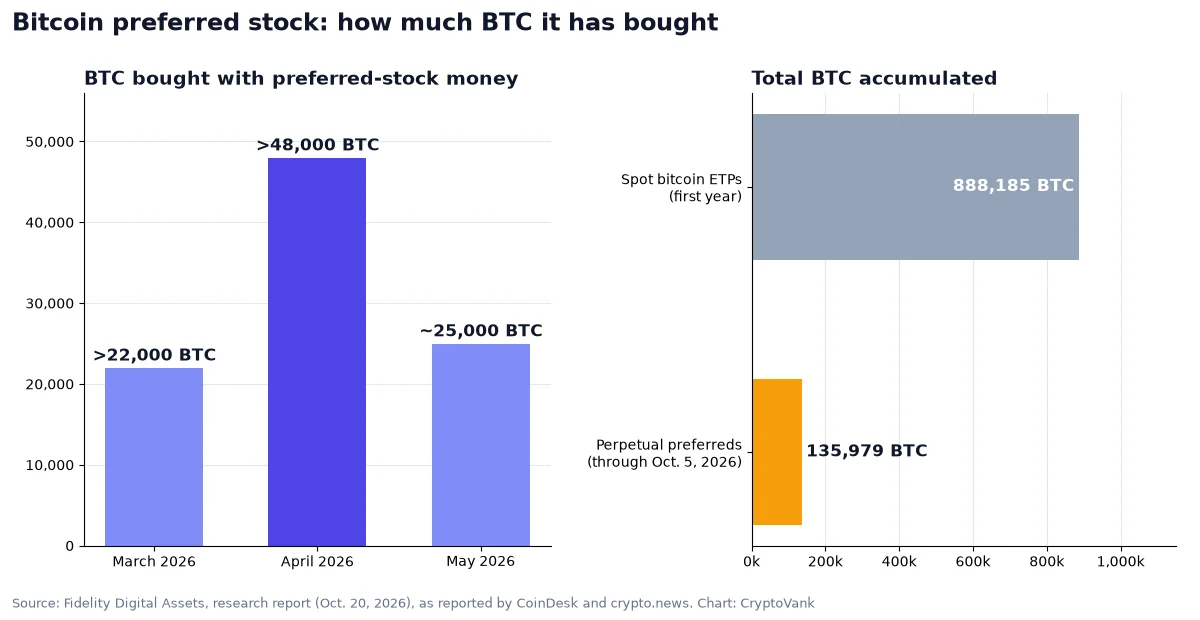
Strategy leads the field with five preferred classes, while Strive started trading a new one this week. Fidelity also put the warning plainly: “For issuers, the strategy only works if the appreciation of the underlying asset outpaces the cost of yield.”
Why bitcoin preferred stock matters for BTC demand
First, it reaches new buyers. “Perpetual preferreds have brought bitcoin to income investors, a group that ETFs never reached,” Mark Palmer of StoneX told CoinDesk. Investors who want steady income rather than price swings can now get bitcoin exposure indirectly.
Second, the scale is still small next to ETFs. The 135,979 BTC equals about 15% of the 888,185 BTC that spot exchange-traded products gathered in their first year. Moreover, Fidelity sizes the whole preferred market at about $12 billion, against roughly $150 trillion of global fixed income. Bitwise’s Ryan Rasmussen told CoinDesk he expects ETFs to remain the bigger source of demand. For context on ETF flows, see our look at the ETF cost basis near $81,500.
Third, the demand is reflexive. “The catch is that the demand for perpetual preferreds is reflexive,” Palmer said. When BTC rises, the shares trade near their $100 par and companies can sell more. When BTC falls, the shares slip below par and new issuance dries up. Two Prime’s Alex Blume noted that STRC fell into the $70s in late June. It now trades around $99.40, per CoinDesk.
The dividend math behind bitcoin preferred stock
Here is where our own numbers come in. Strive priced 7 million SATS shares at $90 on Oct. 15, raising about $630 million, according to its pricing release. However, the 15% dividend is paid on the $100 stated amount, not on $90.
That means $105 million a year in dividends on $630 million raised, an effective cost of about 16.7%. At today’s $80,621, that is roughly 1,300 BTC a year. In other words, if the proceeds go into bitcoin, BTC has to climb about 16.7% a year just to cover the coupon.
Strategy faces the same trade-off at much larger size. CoinShares’ James Butterfill told CoinDesk that STRC raised $7.5 billion in 2026 through late July. Yet in its latest week, Strategy spent $193 million buying back STRC and bought only 267 BTC. It has also raised its preferred buyback authorization to $3 billion. “Buybacks can reduce future dividend costs, but they compete with bitcoin purchases for capital today,” Butterfill said. He added that Strategy has sold some BTC to fund dividends. That shift matters after a run of small buys like last week’s 250 BTC purchase.
Meanwhile, the price backdrop is soft. Bitcoin slipped below $80,000 on Oct. 24, and it remains far below its October 2025 high. That gap squeezes every issuer whose model needs rising prices. Our earlier piece on crypto treasury companies covers how these firms compare.
What to watch next
- Oct. 28: Strategy shareholders vote on paying dividends daily on STRF, STRC, STRK and STRD, per the company’s proxy summary. Rates would not change.
- Oct. 29: Strategy reports third-quarter results after the U.S. close, per its earnings notice. Watch the split between buybacks, dividends and BTC buys.
- Fed meeting: The Federal Reserve meets Oct. 27–28. Lower rates would make a 15% coupon look even richer, which could help demand for new preferreds.
- STRC near par: If STRC holds near $100, Strategy can keep issuing. A slide below $90 would signal the reflexive loop turning down.
FAQ
What is bitcoin preferred stock?
It is perpetual preferred stock sold by a bitcoin treasury company. Buyers receive a dividend and the shares never mature. The company uses the money to buy BTC.
How much bitcoin has preferred stock bought?
Fidelity Digital Assets says 135,979 BTC through Oct. 5, 2026. That is about 0.65% of bitcoin’s 21 million maximum supply.
Is bitcoin preferred stock risky for BTC?
It adds buying when prices rise. But dividends are fixed costs, so a long slump can force buybacks or BTC sales instead of new purchases.
Not financial advice. Do your own research before investing.
Sources
- Fidelity Digital Assets: Perpetual preferred stock, the newest demand catalyst in bitcoin
- CoinDesk: Strategy, Strive face balancing act between bitcoin buying and preferred stock dividends
- crypto.news: Fidelity says preferred stock funded 135,979 bitcoin
- Crypto Briefing: Fidelity identifies preferred stocks as a demand catalyst
- Strive: Pricing of upsized SATS stock offering
- Strategy: Q3 2026 earnings date
- Boardroom Alpha: Strategy special meeting, Oct. 28, 2026
- CoinGecko: Bitcoin price