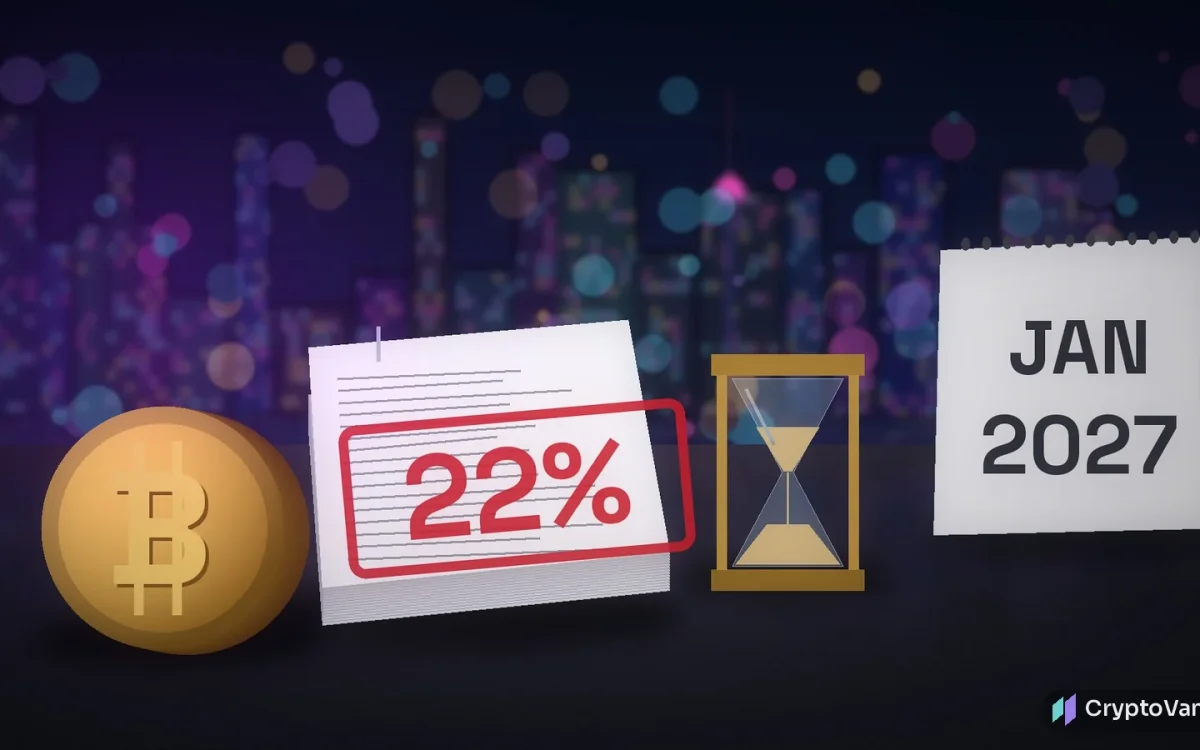
Quick answer: The South Korea crypto tax of 22% is due on Jan. 1, 2027, but a ruling-party bill filed Oct. 16 would push it to 2029. Meanwhile, finance officials meet the heads of Upbit, Bithumb, Coinone, DigitalX and Gopax on Oct. 20, 2026, per Yonhap.
The South Korea crypto tax is due on Jan. 1, 2027, but pressure for a fourth delay is building fast. On Tuesday, Oct. 20, 2026, senior finance officials will meet the country’s five won-based exchanges to review readiness, Cointelegraph reported, citing Yonhap.
The meeting follows a bill from the ruling Democratic Party that would move the start date to 2029. It is the first delay bill from that party, according to Newspim.
What happened ahead of the Oct. 20 meeting?
First Vice Minister of Finance and Economy Kwon Dae-young will attend. So will Yoo Young-jun, the Financial Services Commission’s director general for digital financial policy. They will hear from the heads of Upbit, Bithumb, Coinone, DigitalX and Gopax, plus executives of DAXA, the exchange alliance.
The industry message is already clear, though. “Standards for different transaction types have not yet been finalized,” an exchange official told Yonhap. The official added that there is “a shared view in favor of postponing the start of taxation.”
Meanwhile, lawmaker Park Min-gyu filed his bill on Oct. 16. It ties the start date to the OECD’s Crypto-Asset Reporting Framework (CARF). Under the bill, the tax would begin on Jan. 1 of the second year after Korea first swaps CARF data with other countries. That first swap is expected in 2027, so the tax would start in 2029.
How the 22% crypto tax would work
The rules are already in the Income Tax Act. In short, annual gains from selling or lending crypto above a 2.5 million won deduction face a 20% national rate. A 2% local tax lifts the total to 22%, per the National Assembly Budget Office.
Also, for coins bought before the start date, investors can use the higher of their real cost or the Dec. 31, 2026 market price. After that, residents would file and pay each May for the year before.
This is not a new fight, though. Lawmakers first passed the tax in December 2020 for a January 2022 start, and then delayed it three times. The last delay passed on Dec. 10, 2024, by 204 votes to 33, with 38 abstentions, Yonhap reported.
Why exchanges say they are not ready
The weak spot is infrastructure. Data shown at this month’s parliamentary audit put Upbit furthest along, while Bithumb had not started development, Blockmedia reported. Coinone, for its part, is waiting for the final rules. DigitalX and Gopax are still at early design or testing stages.
On top of that, timing makes this harder. The National Tax Service plans to publish its detailed notice “around November,” then-commissioner Lim Kwang-hyun told lawmakers on Oct. 13. That would leave exchanges less than two months to build, test and explain new reports.
There is also a fairness gap. Lim told the same hearing that gains from offshore perpetual futures would not be taxed. The law covers selling or lending crypto, and a perpetual contract involves neither. In other words, a spot trader on a Korean exchange could pay 22% while a futures trader offshore pays nothing on the same Bitcoin bet.
What the data shows
A Seoul Economic Daily survey of 30 industry officials and experts found 93.3% back a delay. Of those, 96.4% said 2029 or later is the right start. Moreover, 80% want clear rules for staking, airdrops and DeFi first, and 56.7% expect local volume to fall by 30% or more.
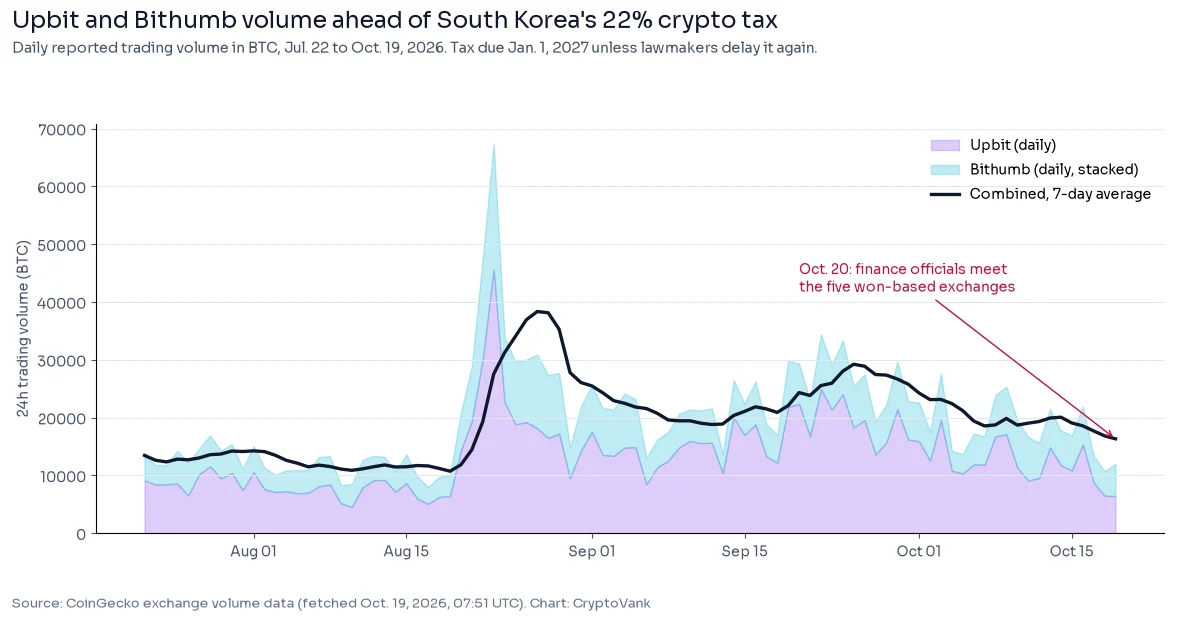
At the same time, local volume is already cooling. Upbit and Bithumb’s combined 7-day average hit about 38,400 BTC on Aug. 27, 2026, per CoinGecko data. By Oct. 19 it had dropped to about 16,300 BTC, a fall of roughly 57%. That move tracks the wider market as much as tax worries, so it is not proof of an exodus yet. Still, it shows how little room the exchanges feel they have.
Bitcoin traded at $82,678, or 110.1 million won, on Oct. 19, 2026, at 07:51 UTC, per CoinGecko. Follow it on our Bitcoin price page.
Our take: the CARF calendar is the real argument
In our view, the strongest case for delay is not market mood but data. Korea is in the first group of 46 jurisdictions set to exchange CARF data in 2027, the Budget Office notes. However, Canada, Switzerland, Singapore and Hong Kong start in 2028, and the US in 2029.
So until those feeds arrive, the tax office cannot easily see coins that move to overseas exchanges or private wallets. As a result, the burden would fall hardest on the most visible users: spot traders on local platforms. A delay keyed to CARF would also give Korea a fixed date instead of another open-ended fight.
For similar debates elsewhere, see how France voted on a stablecoin tax and how Bitget set exit deadlines in three markets.
What to watch next
- Oct. 20 meeting: any statement from the finance ministry or FSC on a timeline.
- November: the tax subcommittee is expected to debate the delay bills, per Seoul Economic Daily.
- NTS notice: a November release would signal the government still plans a 2027 start.
- December: the 2024 delay passed in the year-end tax package, so a new one would likely land there too.
Not financial advice. Crypto is volatile; do your own research (DYOR) before you trade.
South Korea crypto tax FAQ
When does the South Korea crypto tax start?
Under current law, it starts on Jan. 1, 2027. However, a Democratic Party bill filed on Oct. 16, 2026, would delay it to about 2029.
How much is the crypto tax in South Korea?
Gains from selling or lending crypto above 2.5 million won a year face 20% national tax plus 2% local tax, or 22% in total. Residents would file and pay each May for the year before, per the National Assembly Budget Office.
Are offshore crypto futures taxed in South Korea?
No, not under the current law. The National Tax Service commissioner told lawmakers on Oct. 13, 2026, that gains on offshore perpetual futures are not taxable, because the tax only covers selling or lending crypto itself.
Sources
- Cointelegraph: South Korea to meet crypto exchanges amid calls for tax delay (Oct. 19, 2026)
- Newspim: Ruling party files first crypto tax delay bill (Oct. 19, 2026, Korean)
- Blockmedia: Government to meet five exchanges over tax readiness (Oct. 19, 2026, Korean)
- Digital Times: Government calls Oct. 20 exchange meeting (Oct. 18, 2026, Korean)
- Seoul Economic Daily: 93% of crypto industry seeks tax delay (Oct. 19, 2026)
- National Assembly Budget Office: Crypto income tax issues ahead of 2027 (Korean, PDF)
- Yonhap: Crypto tax delayed two years (Dec. 10, 2024, Korean)
- CoinGecko: Bitcoin price and exchange volume data