
Quick answer: Visa said on Oct. 15, 2026, that Visa Direct USDC prefunding has moved from pilot to commercial production. Inyo Global is the first enabler, so eligible payout firms on its platform can fund cross-border Visa Direct payouts with USDC around the clock, subject to eligibility and geographic limits.
Visa has switched on Visa Direct USDC prefunding for real customers. In a press release dated Oct. 15, 2026, the card network said its stablecoin pilots for Visa Direct are now in commercial production, with Inyo Global as the first enabler.
The change sits on the funding side of a payout, not the consumer side. In practice, a money transmitter can now top up its Visa Direct balance with USDC at any hour. Before, it had to wait for a bank wire to land during banking hours.
What did Visa announce?
Visa Direct is Visa’s real-time money movement service. Businesses use it to send payouts to cards, bank accounts and wallets. According to Visa, the stablecoin capability has now moved “from pilot stage to commercial deployment.”
Inyo Global is the first processor to offer it. Inyo serves money transmitters, fintechs, banks and payment companies. Its platform handles onboarding, fraud and compliance checks, acceptance and payouts across more than 180 countries, powered by Visa Direct. The Block confirmed the details on Oct. 16. It added that clients reach the feature through Inyo’s existing APIs.
“The next chapter for stablecoins is adoption,” said Vira Platonova, Global Head of Visa Direct, in the release. PYMNTS carried the same quote. Inyo co-founder Robson Dantas said the new option “is available around the clock.”
Why does prefunding matter?
Cross-border payout firms usually park cash with their provider before they send anything. That buffer is called prefunding. The problem is timing. Bank wires settle in business hours, so a Friday evening spike in payouts can drain the buffer until Monday.
USDC changes that math. Because it moves on public blockchains every day of the week, a firm can refill its Visa Direct balance on a Saturday night. As a result, it can hold a smaller idle buffer and still meet demand. Lower idle balances free up working capital, which matters most for smaller remittance companies.
However, the end user sees nothing new. Recipients still get money through the usual Visa Direct rails. This is plumbing, so the near-term effect on crypto prices should be small.
Data and context: USDC supply and the stablecoin race
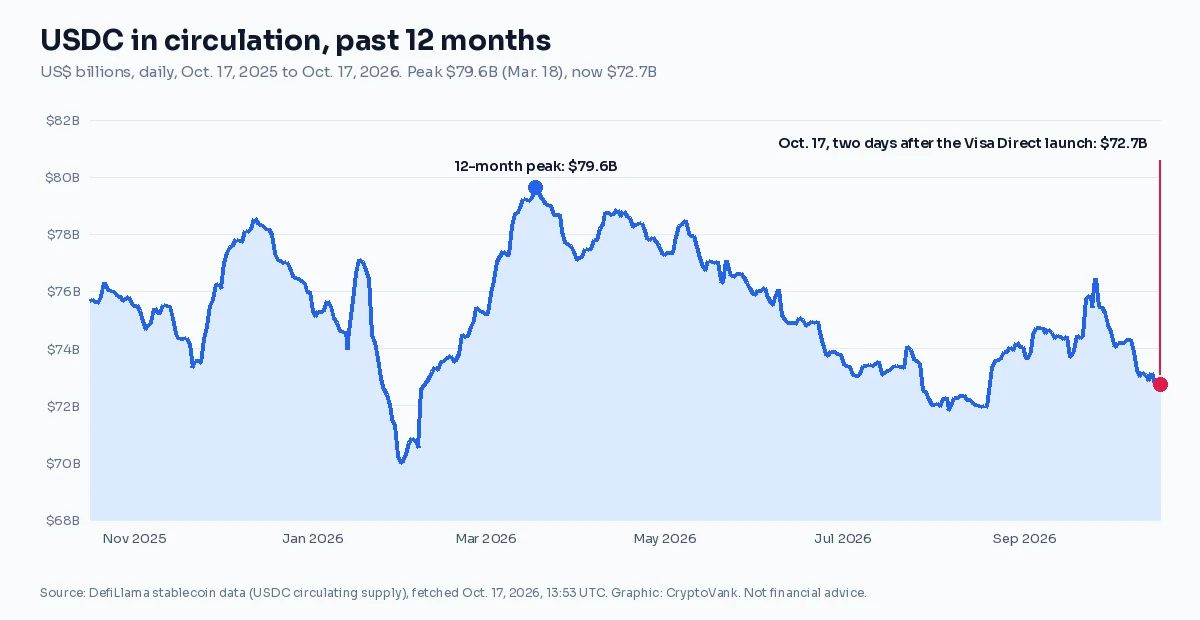
So far, the launch has not moved USDC supply. DefiLlama data shows about $72.7 billion USDC in circulation on Oct. 17, 2026. That is down from $75.7 billion a year earlier and from a 12-month peak of $79.6 billion on March 18. Similarly, CoinGecko put USDC’s market cap at $72.55 billion at 13:52 UTC on Oct. 17. Tether’s USDT stood at $183.5 billion.
Meanwhile, rivals are moving just as fast. Earlier this week, Mastercard unveiled its Global Money Platform with BVNK stablecoin rails. Stripe also expanded its stablecoin cards with Plasma. In Europe, regulators labeled USDC a significant e-money token under MiCA.
Central banks are watching too. On Oct. 17, ECB President Christine Lagarde told the IMF’s International Monetary and Financial Committee that the ECB will run a 12-month digital euro pilot in the second half of 2027. The ECB’s pilot page and Cointelegraph both confirm the plan.
For a primer on the two biggest dollar tokens, see our USDT vs. USDC guide and the stablecoins hub.
What is still missing?
Visa did not publish a list of eligible countries or corridors. In fact, its release says the service is subject to eligibility and geographic restrictions. DeFi Prime points out that the 180-country figure describes Inyo’s payout reach, not USDC prefunding coverage.
Visa also did not disclose fees, volumes or which blockchains carry the USDC. Until it does, the size of the shift is hard to judge.
What to watch next
- Money20/20 USA: Visa said Platonova will discuss stablecoins at several sessions next week. New partners or corridors could come up there.
- A second enabler: Inyo is the first processor. If more Visa Direct processors add USDC, the feature becomes a network standard.
- Payout-side stablecoins: Visa’s 2025 pilots covered both prefunding and payouts. A production launch for stablecoin payouts would reach end users directly.
- USDC supply: Steady growth after launches like this would suggest real business demand.
If you spend crypto day to day, our crypto cards hub compares current options.
Visa Direct USDC FAQ
What is Visa Direct USDC prefunding?
It lets eligible businesses fund their Visa Direct payout balance with the USDC stablecoin instead of only bank wires. Visa moved it into commercial production on Oct. 15, 2026, starting with Inyo Global.
Can individuals use Visa Direct USDC prefunding?
No. It is a business tool for money transmitters, fintechs, banks and payment companies that use Inyo Global. People who receive payouts get them through the usual Visa Direct rails.
Which countries support Visa Direct USDC prefunding?
Visa has not published a country list. Inyo’s platform sends payouts to more than 180 countries, but Visa says USDC prefunding is subject to eligibility and geographic restrictions.
Sources
- Visa: Visa Direct Launches Stablecoin-Powered Money Movement as Pilots Move to Production (Oct. 15, 2026)
- The Block: Visa Direct moves USDC prefunding into commercial production with Inyo Global (Oct. 16, 2026)
- PYMNTS: Visa Direct Offers Money Movement With Stablecoin Prefunding
- DeFi Prime: Visa Direct launches production USDC prefunding
- DefiLlama: USDC circulating supply
- CoinGecko: USDC
- ECB: Digital euro pilot
This article is for information only and is not financial advice.